
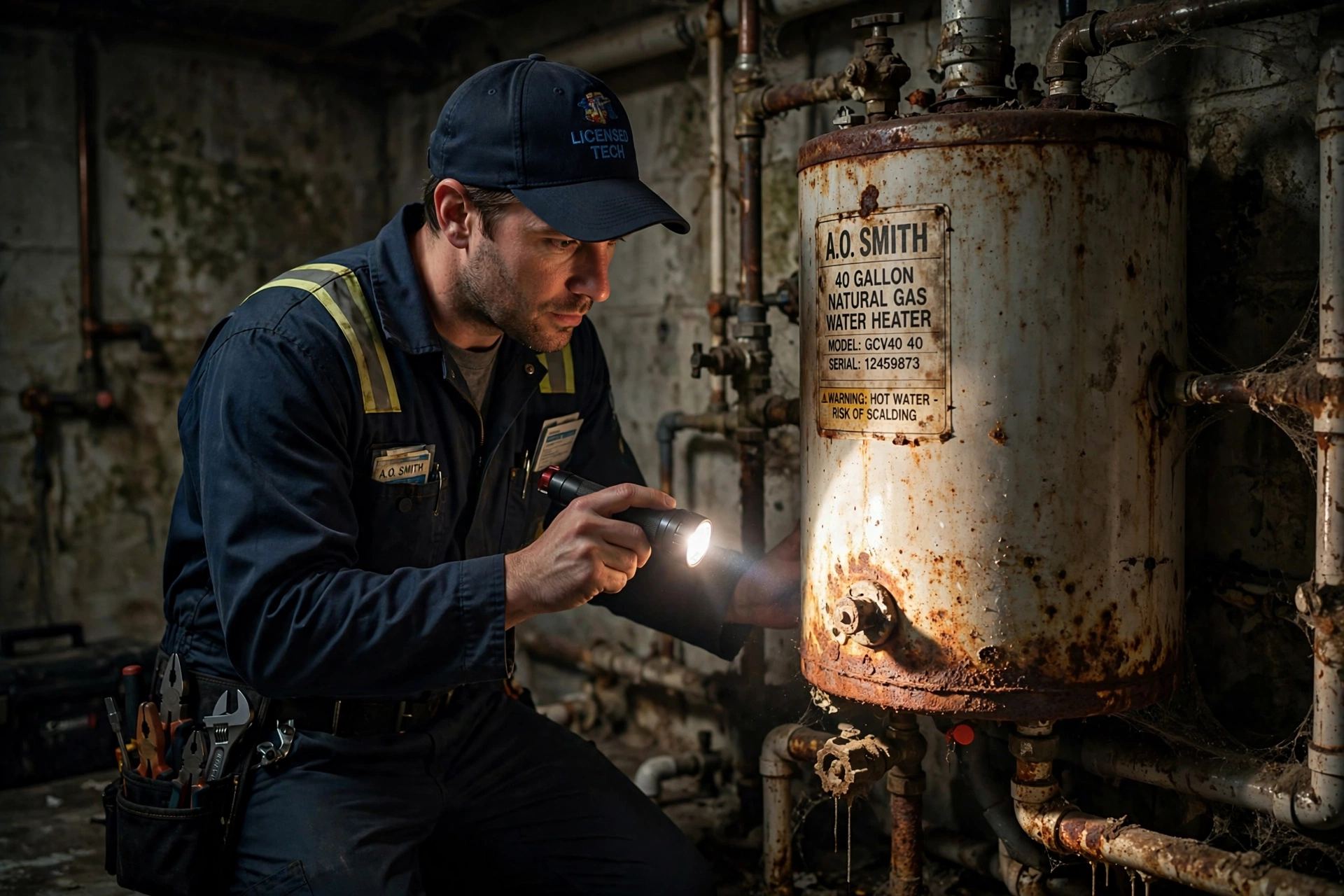
Factor 1: Age of the Unit
Tank heaters last 8–12 years; tankless units 15–20. A young unit deserves the benefit of the doubt; an old one doesn't. Find the age on the rating plate serial number.
Three factors decide repair vs. replace. Here's the exact framework our technicians apply in Lynnwood homes.
Tank heaters last 8–12 years; tankless units 15–20. A young unit deserves the benefit of the doubt; an old one doesn't. Find the age on the rating plate serial number.
Thermostats, elements, thermocouples, and valves are wear parts — designed to be replaced. The steel tank itself is not. Tank failure is the one thing repair can't fix.
The 50% rule: if the repair costs more than half of a new unit and the heater is past two-thirds of its lifespan, put the money toward what's next instead.
We only do repairs — we don't sell new heaters. When we recommend replacement, it's because your tank tells us to, not because there's a commission in it.
Most water heater problems are wear-part failures, and wear parts exist to be replaced. A dead thermostat, a burned-out heating element, a weak thermocouple that won't hold a pilot, a dripping temperature-and-pressure relief valve, a failed gas control valve — these are routine repairs, typically completed in one visit for a fraction of replacement cost.
The math strongly favors repair when your unit is under 8 years old and the fix is a single component. A $200–$400 repair on a 6-year-old tank routinely buys three to five more years of service. That's the best return on money in home maintenance, and any honest technician will tell you so.
Even at 9 or 10 years, a modest repair usually makes sense if the tank itself is sound — no rust weeping, no prior repeat failures. Age alone isn't a death sentence; condition is what matters. Call 8665723596 and we'll help you read the signs before you spend anything.
You don't need to guess. Here's how a diagnostic visit settles the question.
Inspect
We check the tank's condition first — rust, weeping, corrosion at fittings — because the tank's verdict overrides everything else.
Test
Components get tested, not guessed at: elements, thermostats, gas valve, thermocouple, and water pressure.
Price Honestly
You get the repair cost, the unit's age and condition, and our plain-English recommendation — repair or move on.
Your Call
No pressure either way. If repair makes sense, we fix it on the spot. If not, you get clear facts for your next step.
Multimeter & Element Tester
Confirms whether elements and thermostats are truly dead or just misbehaving.
Combustion & Draft Check
Reveals venting and burner problems that mimic bigger failures on gas units.
Tank Integrity Inspection
The critical one: we look for the rust and weeping that mark a tank beyond saving.
Water Pressure Gauge
High pressure kills tanks early — we check it because it changes the whole recommendation.
Tank-First Assessment
The steel tank's condition is judged before any component, because it decides everything.
The 50% Rule, Applied Openly
We show you the math: repair cost vs. unit age vs. replacement — no hidden agenda.
Documented Findings
You see what we see. If we say the tank is done, we'll show you exactly why.
01
What we do: A 5-year-old tank with a dead element or a 7-year-old gas unit with a bad thermocouple is a textbook repair. One visit, a few hundred dollars, years of life left.
→ Fix it today, enjoy hot water tonight, revisit in years.
02
What we do: A 10-year-old tank needing a $400 valve is the gray zone. We lay out both sides honestly: the repair buys time, but the tank's clock is ticking.
→ You decide with full information — never a sales pitch.
03
What we do: Rust weeping through the jacket or water from the tank body means the steel is done. No ethical company repairs that — and we'll tell you so directly.
→ A straight answer now saves you from paying twice later.
You can do a surprising amount of this assessment before anyone visits. Check the manufacture date on the rating plate — if your tank is pushing 12+ years, start planning rather than reacting. Look at the base of the tank and around fittings for rust streaks or mineral crust: rust on a fitting is often fixable, but rust weeping from the tank jacket itself is the end of the road.
Listen, too. Rumbling or popping on a gas unit usually means heavy sediment — annoying and inefficient, but not fatal. A T&P valve that keeps discharging, on the other hand, signals pressure or temperature problems that need a professional's eyes quickly.
And remember the golden rule of this guide: components can be replaced, tanks cannot. Everything else is just math — which is exactly what we'll walk through with you, honestly, at 8665723596.
The repair-vs-replace math isn't the same everywhere. Here's what tilts it in Lynnwood specifically.
Alderwood Manor
Older homes with original 12–15-year-old tanks — here, 'repair or replace' comes up constantly, and honesty matters most.
Lynnwood City Center
Newer condos and apartments with younger units — repair almost always wins when something fails early.
Meadowdale
Family homes in the 8–12 year sweet spot where a good diagnosis saves real money either way.
Snohomish County Airport Area
Mixed properties where we see both residential tanks and light-commercial units aging out.
Hard water
Lynnwood's mineral-heavy water eats anode rods and builds sediment — the two biggest lifespan killers for tanks.
Cold winters
Winter failures force fast decisions. Knowing this framework ahead of time keeps a cold-night breakdown from becoming a panic purchase.
Older housing stock
Many Lynnwood tanks are already past year 10. An honest condition check now beats an emergency later.
These are the exact judgment calls our technicians make in Lynnwood homes.
Problem
The unit is inside its normal lifespan and the fix is a wear part well under the 50% threshold.
Our Fix
Repair it. This is the best-value move in water heating — expect several more years of reliable service for a modest bill.
Problem
Moisture and rust streaks coming through the steel body itself, not from a fitting or valve.
Our Fix
Don't repair — and don't let anyone sell you a patch. The tank has structurally failed. We'll confirm it, make everything safe, and give you straight facts for your next step.
Problem
Repeated component failures on an old tank usually mean systemic decline, not bad luck.
Our Fix
We'll fix what's broken today if you want, but we'll tell you plainly that you're likely throwing good money after bad — and show you why.
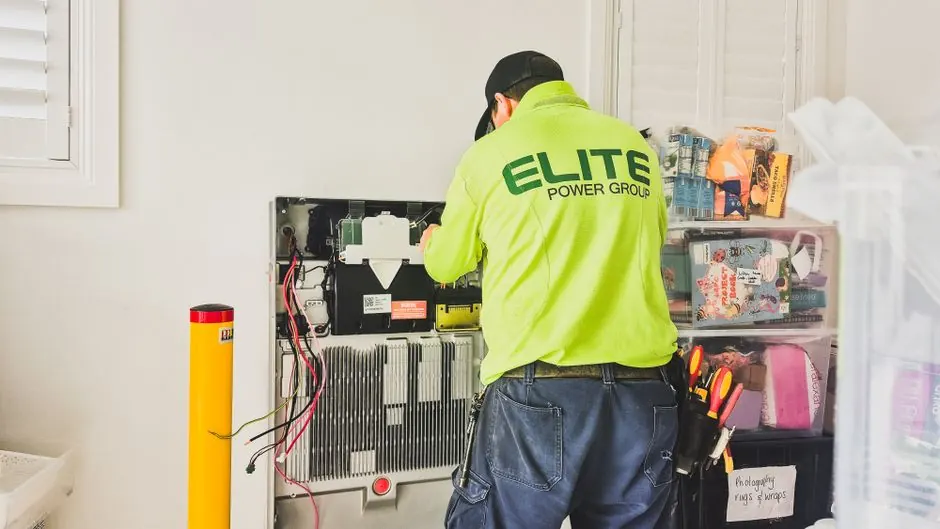
We're the only ones in this conversation with nothing to sell you but the truth.
Zero conflict of interest
We don't sell or install new heaters. Recommending replacement earns us nothing — so when we do, believe it.
Tank-first diagnosis
We judge the steel before the parts, because that's the verdict that actually matters.
The math, shown openly
Repair cost, unit age, remaining life — we walk through the 50% rule with you, not around you.
No pressure, ever
You'll never get a 'sign today' pitch. Take our diagnosis, think it over, call us back — or don't.
24/7 emergency repairs — hot water problems don't wait for business hours, and neither do we.
Same-day service in Lynnwood — call before noon and we aim to be there today.
All systems & buildings — gas, electric and tankless units; residential and commercial.
Settling 'repair or replace' correctly is the highest-value skill in this trade — it saves homeowners from both premature replacement and wasted repairs. Our technicians make this call dozens of times a month across Lynnwood, and our reputation depends on getting it right.
Real answers to the questions we hear most often from local homeowners and property managers.
Is your leak repairable or terminal? We find the source and give you the honest verdict.
View Leaking Water Heater RepairNo hot water doesn't mean dead heater — most causes are quick, affordable repairs.
View No Hot Water RepairNeed this answer right now? Our 24/7 line gives straight guidance, even at 2 AM.
View Emergency RepairTankless units play by different rules — 15–20 year lifespans and very repairable components.
View Tankless Water Heater RepairFor reliable water heater repair services in Lynnwood, reach out to us. We are available 24/7 for your convenience and respond quickly to all inquiries.
Call now for same-day service
Talk directly to a water heater pro — no waiting on hold. 24/7 emergency service available.
8665723596Phone
8665723596Address
2250 186th St SW #109, Lynnwood, WA 98037, USA
Hours
Mon–Fri: 7AM – 7PM
Sat: 8AM – 4PM
Sun: Emergency Only
24/7 Emergency Available