
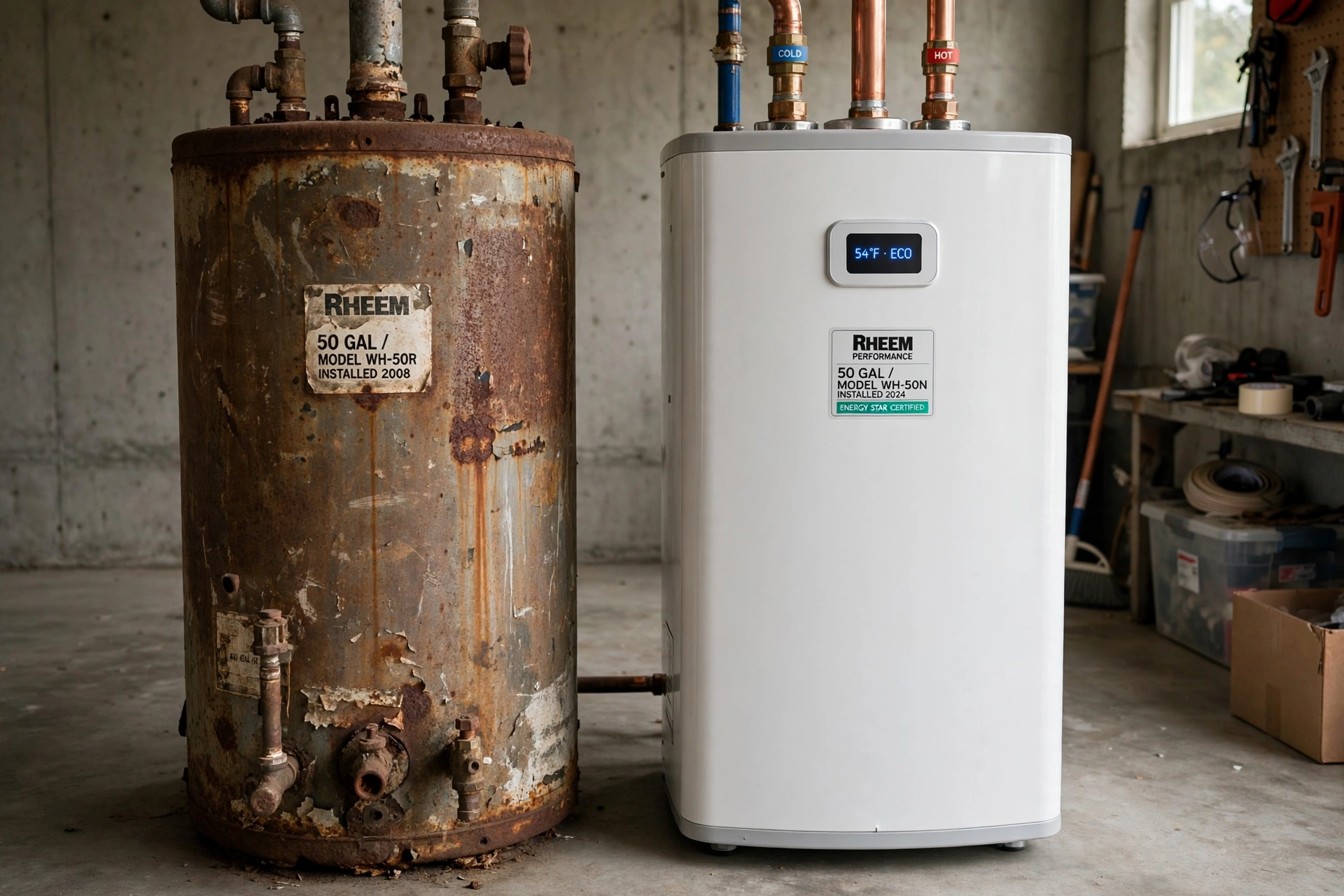
A standard tank water heater in Lynnwood typically lasts 8 to 12 years, while a tankless unit usually lasts 15 to 20 years. Those ranges shift with water quality, usage, and how the unit was installed — which is why two identical heaters can die five years apart. This guide explains what determines lifespan, how to find your unit's age, the warning signs of a dying heater, and when a repair is still worth it.
How long does a standard tank water heater last?
A conventional tank water heater — gas or electric — is built around a steel tank lined with glass. The lining eventually cracks, the steel starts to corrode, and the tank begins to weep. In Lynnwood homes that process typically takes 8 to 12 years.
The warranty on your unit is a rough proxy for its expected life. A basic 6-year-warranty tank is built to a price; 9- and 12-year models usually have thicker anode rods and better linings. Neither number is a guarantee — we regularly see 6-year tanks survive 14 years in soft-water homes, and 12-year tanks fail at 9 in hard-water areas with heavy sediment.
Gas and electric tanks last about the same length of time. The difference is what fails: gas units tend to lose burners, gas valves, and thermocouples, while electric units lose heating elements and thermostats. The tank itself fails on roughly the same schedule either way.
How long do tankless water heaters last?
Tankless (on-demand) water heaters last considerably longer — typically 15 to 20 years, and sometimes more. The reason is simple: there is no tank of water sitting against steel for a decade. The heat exchanger only sees water while it is heating it.
That longer life comes with a condition. Tankless units need periodic descaling, especially in areas with mineral-heavy water. A tankless heater that has never been descaled can develop flow problems and error codes years before its time. If your tankless unit is showing error codes or fluctuating temperatures, that is usually a maintenance or repair issue — not the end of the unit.
What shortens a water heater's lifespan in Lynnwood?
Lynnwood's municipal water is moderately hard, which means mineral sediment settles in tank heaters over time. Sediment is the number one lifespan killer we see:
- Sediment buildup: A layer of minerals on the tank floor insulates water from the burner or element, forcing longer heating cycles and overheating the steel. You will often hear it first as popping or rumbling.
- High water pressure: Pressure above 80 PSI stresses the tank, valves, and connections. An expansion tank and pressure regulator protect the whole system.
- Temperature set too high: Running at 140°F or more accelerates mineral precipitation and tank wear — and creates a scalding risk. 120°F is the sweet spot.
- Depleted anode rod: The anode rod sacrifices itself to protect the tank lining. Once it is gone, the tank corrodes directly. This is the most overlooked lifespan factor in older units.
- Poor venting (gas units): Improper venting causes condensation and corrosion on gas water heaters, shortening burner and flue life.
What are the signs your water heater is dying?
Age alone does not condemn a water heater — symptoms do. Watch for this combination:
- Its age is past the warranty period and problems are stacking up, not isolated.
- Rusty or discolored hot water (cold water runs clear) — often the first sign the tank lining has failed.
- Rumbling or banging that keeps getting louder — heavy sediment the tank can no longer shed.
- Moisture or rust around the base — a weeping tank cannot be patched; the steel is compromised.
- Inconsistent temperatures or noticeably longer recovery times.
- Rising energy bills with no change in usage — the unit is working harder for the same hot water.
One symptom in a younger unit usually means a repairable part. Several symptoms in a 10+ year old unit usually means the tank is telling you its time is up. If you are hearing new noises, our guide to water heater noises explains what each sound means.
Can an aging water heater be repaired instead of replaced?
Often, yes — and this is where an honest diagnosis matters. Many “dead” water heaters just need a part:
- Heating elements and thermostats (electric) — the most common no-hot-water fix, very repairable.
- Thermocouples and gas valves (gas) — pilot and ignition problems are usually component-level.
- T&P relief valves and drain valves — leaks from fittings and valves are repairable; leaks from the tank wall are not.
- Anode rod replacement — can add years to a tank that is otherwise sound.
The line we draw: if the tank itself is leaking or rusted through, no part replacement will save it. Everything else is usually worth diagnosing. A good rule of thumb — if the unit is under 10 years old and the tank is sound, repair is almost always the smart money. Call 8665723596 and we will tell you straight which side of that line you are on.
How can you find your water heater's age?
Check the serial number on the manufacturer's rating plate (usually on the side of the tank). Most brands encode the manufacture date in the first few characters — commonly the month and year, though the exact format varies by brand (Bradford White, Rheem, and A.O. Smith all do it differently).
If the plate is faded or you cannot decode it, note the model number and call us at 8665723596 — we can usually date a unit from the model alone. Knowing the age changes the conversation: a failed element at year 6 is a clear repair; the same failure at year 13 deserves a harder look at the tank's overall condition.
When should you call for a professional diagnosis?
Call when you notice any of the dying signs above — especially rust-colored hot water, moisture around the base, or a unit past 10 years that is acting up. A diagnosis visit is quick: we check the tank's condition, test the components, and give you an honest repair-or-replace assessment.
The Heater Medics provides no hot water repair and full diagnostic service across Lynnwood — Alderwood Manor, Lynnwood City Center, Meadowdale, and surrounding neighborhoods. Same-day service is available when you call before noon at 8665723596.
Frequently Asked Questions
How long does a typical tank water heater last? Most tank water heaters last 8 to 12 years. Gas and electric tanks have similar lifespans; what usually differs is which components fail first.
Do tankless water heaters really last longer? Yes — typically 15 to 20 years, because there is no tank of water corroding steel. They still need periodic descaling to reach that lifespan.
How do I find the age of my water heater? Check the serial number on the manufacturer's rating plate on the tank. Most brands encode the manufacture month and year in the first characters.
Does hard water shorten water heater life? Yes. Mineral sediment settles on the tank floor, insulates the burner or element, and accelerates wear. Lynnwood's moderately hard water makes this a real factor.
Is it worth repairing a 12-year-old water heater? It depends on the tank's condition. If the tank is sound and the problem is a component like an element or thermostat, repair usually makes sense. A leaking tank means replacement.
What kills water heaters fastest? Sediment buildup, high water pressure, excessive temperature settings, and a depleted anode rod are the top lifespan killers we see in Lynnwood.