
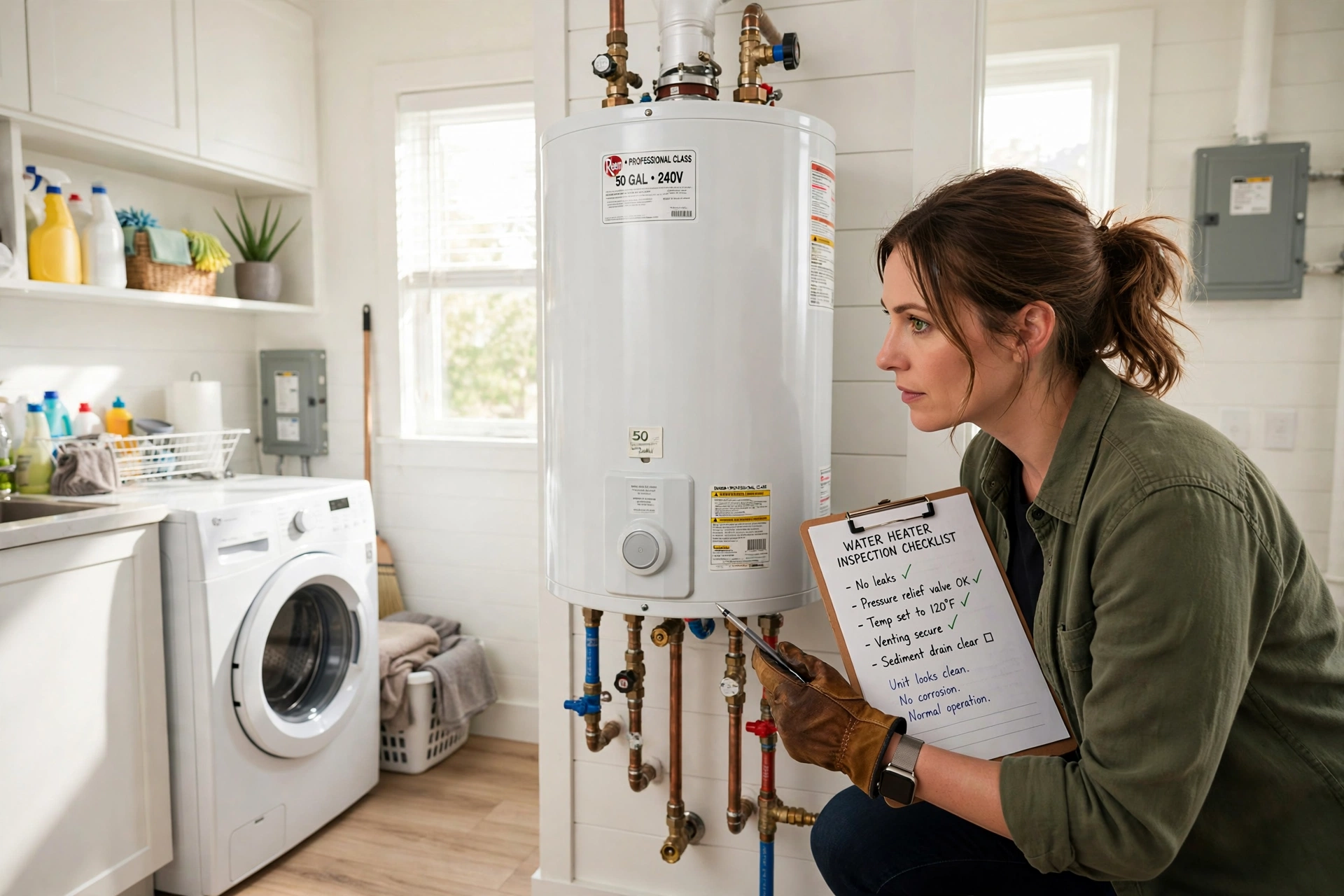
An honest note first: we are a repair company, not a maintenance-plan company. We don't sell annual service contracts. But after years of repair calls across Lynnwood, we can tell you exactly which simple homeowner habits prevent the failures we get called for. Every tip below is free, takes minutes, and requires no tools — and we will also tell you clearly what not to touch.
What temperature should your water heater be set to?
120°F. This is the single highest-value setting on your water heater, and it takes ten seconds to check:
- Safety: Water above 140°F can scald in seconds — a real risk for kids and older adults. 120°F is comfortably hot without the danger.
- Equipment life: Higher temperatures accelerate mineral precipitation, which means faster sediment buildup — the #1 lifespan killer we see in Lynnwood tanks.
- Energy: Every 10°F reduction saves a noticeable slice of water-heating energy.
On gas units the dial is on the gas control valve; on electric units the thermostats sit behind the access panels (power off before touching anything inside). If your water is scalding or barely warm at the tap despite a 120°F setting, the thermostat itself may be failing — see electric water heater repair.
What should you look at during a monthly visual check?
Once a month, spend sixty seconds looking at your water heater. You are checking for four things:
- Water where it shouldn't be — dampness, drips, or mineral crust around the base, fittings, valves, and the T&P discharge pipe. Early catches here are the difference between a valve replacement and water damage. Our leaking water heater guide shows what to do if you find moisture.
- Rust or corrosion — orange streaks on fittings, rust flakes on the burner access area, or corrosion on pipe connections. Surface rust on a fitting is a watch item; rust on the tank body is a call-us item.
- Venting (gas units) — the vent pipe should be firmly connected, sloping upward, with no visible gaps or corrosion holes. A disconnected vent is a carbon monoxide risk — do not use the unit until it is checked.
- Clearance — keep the area around the heater clear of boxes, paint cans, and clutter. Gas units need combustion air; every unit needs access for service.
Why should you listen to your water heater?
Your ears are a free diagnostic tool. Once in a while, stand near the unit while it heats a tank (after a shower is ideal) and listen:
- Quiet operation — normal. Nothing to do.
- Popping or rumbling — sediment building up on the tank floor. Mention it at your next service visit, or call if it is getting louder. Our noise guide decodes every sound.
- Hissing with no visible steam — could be condensation (normal on cold tanks) or a small leak dripping on something hot. Look for moisture to tell the difference.
- New sounds that were not there before — any change deserves attention. Water heaters fail gradually, and sound is usually the first signal.
What about the temperature-and-pressure (T&P) relief valve?
The T&P valve is your water heater's most important safety device — it releases water if temperature or pressure climbs too high. What homeowners should know:
- Know where it is (side or top of the tank) and make sure its discharge pipe runs down toward the floor, unobstructed.
- Watch for dripping. A T&P valve that drips or discharges frequently is telling you about excessive pressure or temperature — that is a symptom to get checked, not a quirk to ignore.
- Be cautious about “test” levers on old valves. Flipping the test lever on an aging valve can prevent it from reseating, turning a test into a leak. If your valve is many years old and you have never tested it, mention it to a technician instead of testing it yourself — call 8665723596 and we will advise whether yours needs attention.
What should you never DIY on a water heater?
Clear boundaries keep you safe:
- Gas lines and gas pressure — never. If you smell gas, leave and call your utility.
- Electrical elements and wiring — 240 volts deserves respect; leave panel work to a pro.
- Opening sealed combustion or removing burner assemblies on gas units.
- Anything involving the tank itself — no sealants, no patches, no tightening a weeping tank fitting and hoping.
The homeowner's job is observe and report: settings, sights, sounds, and smells. The technician's job is everything inside the jacket. That division keeps everyone safe — and it is exactly how our tankless and tank repair visits work most efficiently: you describe the symptom, we bring the right parts.
When does DIY end and a repair call begin?
Call The Heater Medics when any check above turns up something wrong — moisture, rust on the tank, venting issues, persistent noises, a dripping T&P valve, or water that is too hot, too cold, or discolored. That is precisely what these habits are for: catching the small stuff before it becomes the big stuff.
We provide honest, same-day water heater repair across Lynnwood — Alderwood Manor, Lynnwood City Center, Meadowdale, and nearby neighborhoods. Call 8665723596 before noon for same-day service, or browse more repair guides on our blog.
Frequently Asked Questions
What is the best temperature setting for a water heater? 120°F for most homes. It is hot enough for comfortable use, cool enough to prevent scalding, and it slows mineral sediment buildup that shortens tank life.
How often should I check my water heater? A quick 60-second visual check once a month — look for moisture, rust, venting issues, and clearance — plus listening for new noises now and then. That is enough for most homeowners.
Should I test my T&P relief valve? Know where it is and watch for dripping, but be cautious flipping the test lever on an old valve — it may not reseat and can start leaking. Mention it to a technician instead.
Do I need to flush my water heater every year? Flushing helps with sediment, but opening an old drain valve can cause it to leak. If your unit has never been flushed and is several years old, have a professional assess it first rather than forcing the valve.
What maintenance can I safely do myself? Check the temperature setting, do monthly visual inspections, listen for new noises, and keep the area clear. Leave gas, electrical, and internal components to a professional.
We don't sell maintenance plans — why publish maintenance tips? Because informed homeowners catch problems early, and early catches mean simpler repairs. We would rather earn your repair call with honesty than sell you a contract.