
TPR valve dripping or blowing off
The relief valve opens when tank pressure climbs too high. If it drips after every heating cycle, lost expansion control is the likely culprit.
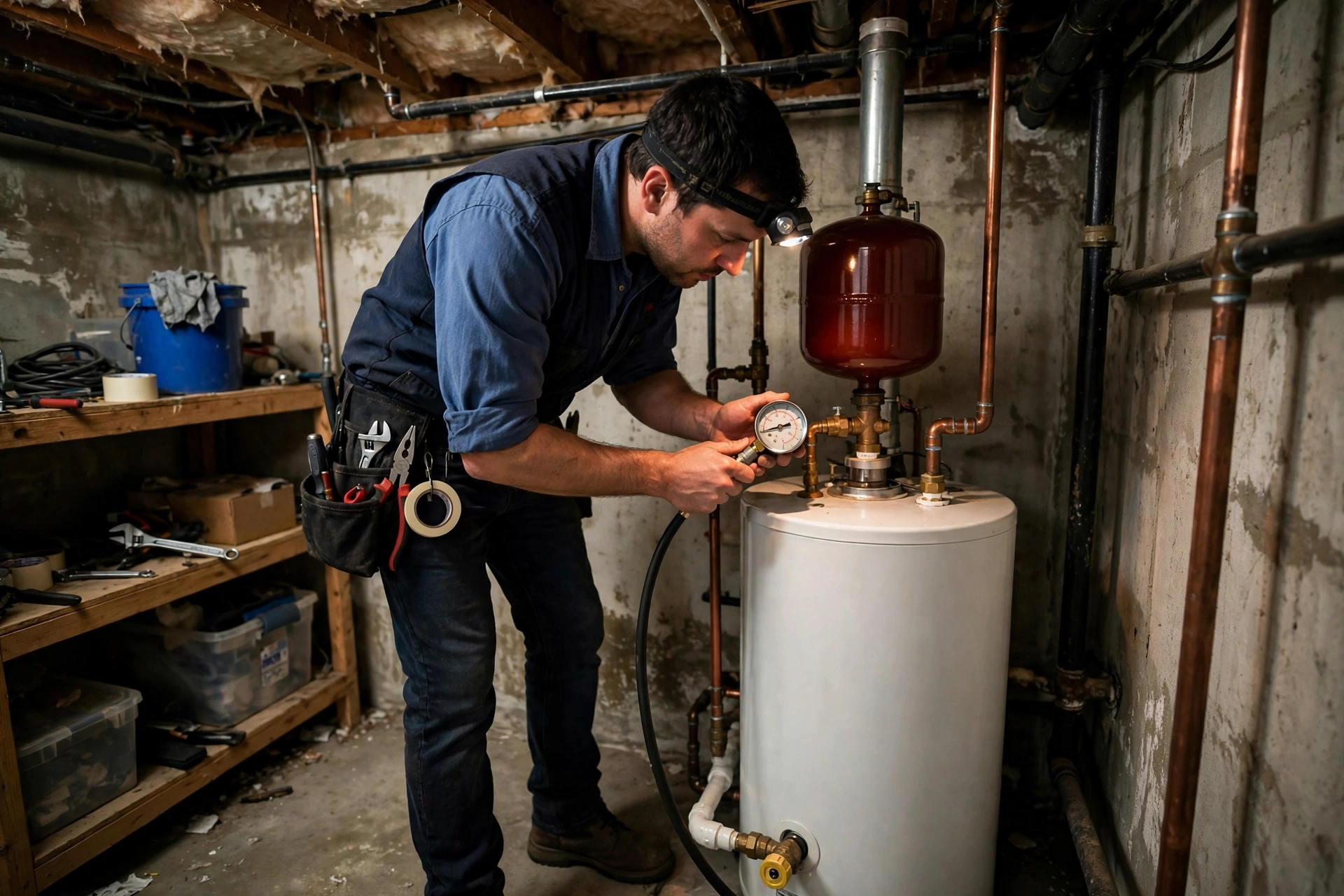
An expansion tank is a small tank mounted above or beside your water heater that gives heated water somewhere to go. Water expands as it heats, and in an older open plumbing system that extra volume simply pushed back out into the city main. Most Lynnwood homes, though, have a pressure-reducing valve or check valve on the incoming line — one-way valves that make the system “closed.” When the water heats up, the pressure has nowhere to escape.
The tank absorbs it. Inside is a rubber bladder or diaphragm with pressurized air on one side and a connection to your plumbing on the other. Expanding water pushes in and compresses the air cushion; when water cools or a faucet opens, the air pushes it back out. Without that cushion, every heating cycle becomes a pressure event that stresses your heater, relief valve, supply lines, and fixtures. Expansion control on a closed system is also a standard plumbing-code requirement — inspectors look for it, and a home with a pressure-reducing valve but no expansion tank is overdue for one.
A failed expansion tank rarely announces itself politely. If two or more of these sound familiar, the tank deserves a proper test.
The relief valve opens when tank pressure climbs too high. If it drips after every heating cycle, lost expansion control is the likely culprit.
Pressure jumping well above normal after the heater runs, then settling back, is the signature of a failed expansion tank.
Loud bangs when a faucet or washer shuts off point to pressure already riding high. A dead tank lets normal pipe shocks turn violent.
A healthy tank is mostly air and feels light when tapped. A waterlogged tank — ruptured bladder — fills solid with water and feels heavy.
Sweating or rust streaks on the shell mean water is sitting where only air should be. Rust means it has been failing for a while.
Running toilets, dripping faucets, and small leaks at washer hoses or heater connections can all trace back to elevated pressure.
Most failures come down to a few predictable causes. The most common is a ruptured bladder: the membrane inside splits, water floods the air side, and the tank waterlogs — that tank has to be replaced. The second is a slow loss of air charge through the Schrader valve (a tire-valve-style stem); if the bladder is intact, the tank can simply be recharged.
One pattern worth calling out: a dripping TPR valve is often treated by replacing the valve alone. If the real problem is lost expansion control, the new valve starts dripping again within days. That is why our TPR valve repair service always includes an expansion check.
Usually, yes — especially when the dripping follows a pattern. If your relief valve drips or blows off shortly after a full heating cycle and then stops, that is the classic fingerprint of thermal expansion with nowhere to go. The valve is doing its job; the missing piece is expansion control.
Replacing the valve alone does not change the pressure cycle — it just gives the same excess pressure a new, clean valve to blow through. We see this loop regularly: a homeowner swaps the TPR valve, and the dripping comes right back. The fix is to restore the cushion: test the tank, recharge it if the bladder is intact, or replace it if it is waterlogged. Once pressure has somewhere to land, the relief valve stays dry. Unsure what you are dealing with? Start with a water heater diagnostic visit before buying parts.
On a closed system — one with a pressure-reducing valve or check valve — every heating cycle raises pressure with nowhere for it to go. The relief valve vents the excess and wears itself out in the process, while the spikes stress supply lines, washer hoses, toilet valves, faucet cartridges, and the heater itself. Over months this accelerates leaks and shortens component life, and because code requires expansion control on closed systems, a missing tank can also surface during a home inspection.
Nothing dramatic happens on day one, but the system quietly beats itself up on every cycle. Before a pressure spike finds the weakest hose in the house, get it checked — that is exactly the kind of call our emergency water heater repair line exists for.
Expansion tank repair is a diagnostic job first and a parts job second — replacing a tank that only needed a recharge wastes your money, and recharging a ruptured bladder wastes everyone’s time. Here is how we work through it:
Isolate and relieve pressure
We shut off the heater’s supply and open a hot tap to relieve system pressure first.
Test the air charge
A gauge on the Schrader valve reveals the pre-charge. Water from the air valve means a ruptured bladder; low air with an intact bladder means a recharge may fix it.
Tap test and inspect
Tapping top to bottom: hollow ring up top, dull thud at the bottom is normal; dull everywhere means waterlogged. We also check shell, fittings, and support.
Recharge or replace
An intact but discharged tank is recharged to match your house pressure, with a new valve core if needed. A waterlogged or corroded tank is replaced with the correct size and proper support.
Verify under a heating cycle
We restore pressure and run a full heating cycle, confirming pressure stays stable and the relief valve stays dry. The job is not done until a real cycle proves it.
A recharge typically takes well under an hour, and a straightforward replacement is usually handled in the same visit. Need it done today? Our same-day repair service covers expansion tank calls too.
A tank only works when it is big enough and its air pre-charge matches your home’s water pressure. Think of the pre-charge like the air in a shock absorber — if it does not match the water pressure pushing against it, the bladder sits in the wrong position and the tank cannot absorb a full heating cycle.
So we measure your incoming pressure first (usually at an outdoor hose bib or the heater’s drain valve) and set the charge to match it. A wrongly charged tank behaves almost like a failed one: the relief valve still drips, and homeowners assume the new tank is defective when the real problem is calibration. Sizing matters too: the tank needs enough acceptance volume for your heater’s full volume, or pressure spikes at the end of long cycles. When we replace a tank we size it to the heater and measured pressure, with proper support — a water-filled tank is heavy and should never hang by its pipe connection alone.
Two safe checks take about a minute. First, the tap test: tap the tank top to bottom with your knuckles. The top should ring hollow; the bottom sounds duller because it holds some water. A dull, solid thud everywhere means it is waterlogged — the bladder has failed.
Second, the air valve check: press the Schrader valve pin briefly. Air hissing out is normal; water coming out means a ruptured bladder and the tank needs replacement; nothing at all means the charge bled away and it may just need a professional recharge. Do not recharge it yourself with a compressor — the charge must be set with the system depressurized and matched to house pressure. And if the tank is rusted, leaking, or poorly supported, leave it alone and call us.
Sometimes the expansion tank is a symptom of a heater at the end of its life. If the heater itself leaks from the tank — not from fittings, the relief valve, or connections — or it is well past its service life and needs frequent repairs, money spent around it may be better directed at the heater. Our repair-vs-replace guide walks through that decision honestly.
But a failed expansion tank on an otherwise healthy heater is a straightforward repair, not a reason to replace the heater. The tank is a separate component with its own lifespan. If yours heats reliably and holds water, fix the expansion side — and our leaking water heater repair page can help you tell tank leaks from fitting leaks.
Surprising to many homeowners: expansion tanks are universal. Rheem, AO Smith, Bradford White, Rinnai, Navien, Noritz — every brand’s water heater uses the same kind of thermal expansion tank, sized by water volume and pressure, not by brand. No proprietary part, no compatibility puzzle, no waiting on a special order.
That means our technicians carry the common sizes on the truck. The real skill is in diagnosis and calibration — testing the bladder, measuring house pressure, setting the pre-charge — not in sourcing an exotic part.
We service expansion tanks throughout Lynnwood. In Alderwood Manor and around Lynnwood City Center, pressure-reducing valves are common on the municipal supply — closed systems whose expansion tanks need periodic attention. Older homes in Meadowdale and North Lynnwood often have tanks that have been quietly waterlogged for years, discovered only when the relief valve starts dripping or a washer hose lets go.
Around Martha Lake and Lake Serene we see a mix: newer construction that just needs a recharge, and remodels where the heater was swapped but the old undersized tank was left behind. The approach is the same everywhere in Lynnwood — test first, recharge when the bladder is sound, replace when it is not. Call 8665723596: Mon–Fri 7AM–7PM, Sat 8AM–4PM, with 24/7 emergency service if a relief valve is discharging and will not stop. For more on pressure-driven leaks, see our guide to water heater leaks on the blog.
Real answers to the questions we hear most often from local homeowners and property managers.
A dripping relief valve is the most common sign of lost expansion control. See how we diagnose and fix TPR discharge at its source.
View TPR Valve RepairNot every drip is a tank failure. Learn to tell fitting leaks, valve discharge, and true tank leaks apart — and what each one needs.
View Leaking Water Heater RepairPressure spikes, strange discharge, or noises you cannot explain? A full diagnostic pinpoints whether the expansion tank is the culprit.
View Water Heater DiagnosticFor reliable water heater repair services in Lynnwood, reach out to us. We are available 24/7 for your convenience and respond quickly to all inquiries.
Call now for same-day service
Talk directly to a water heater pro — no waiting on hold. 24/7 emergency service available.
8665723596Phone
8665723596Address
2250 186th St SW #109, Lynnwood, WA 98037, USA
Hours
Mon–Fri: 7AM – 7PM
Sat: 8AM – 4PM
Sun: Emergency Only
24/7 Emergency Available