
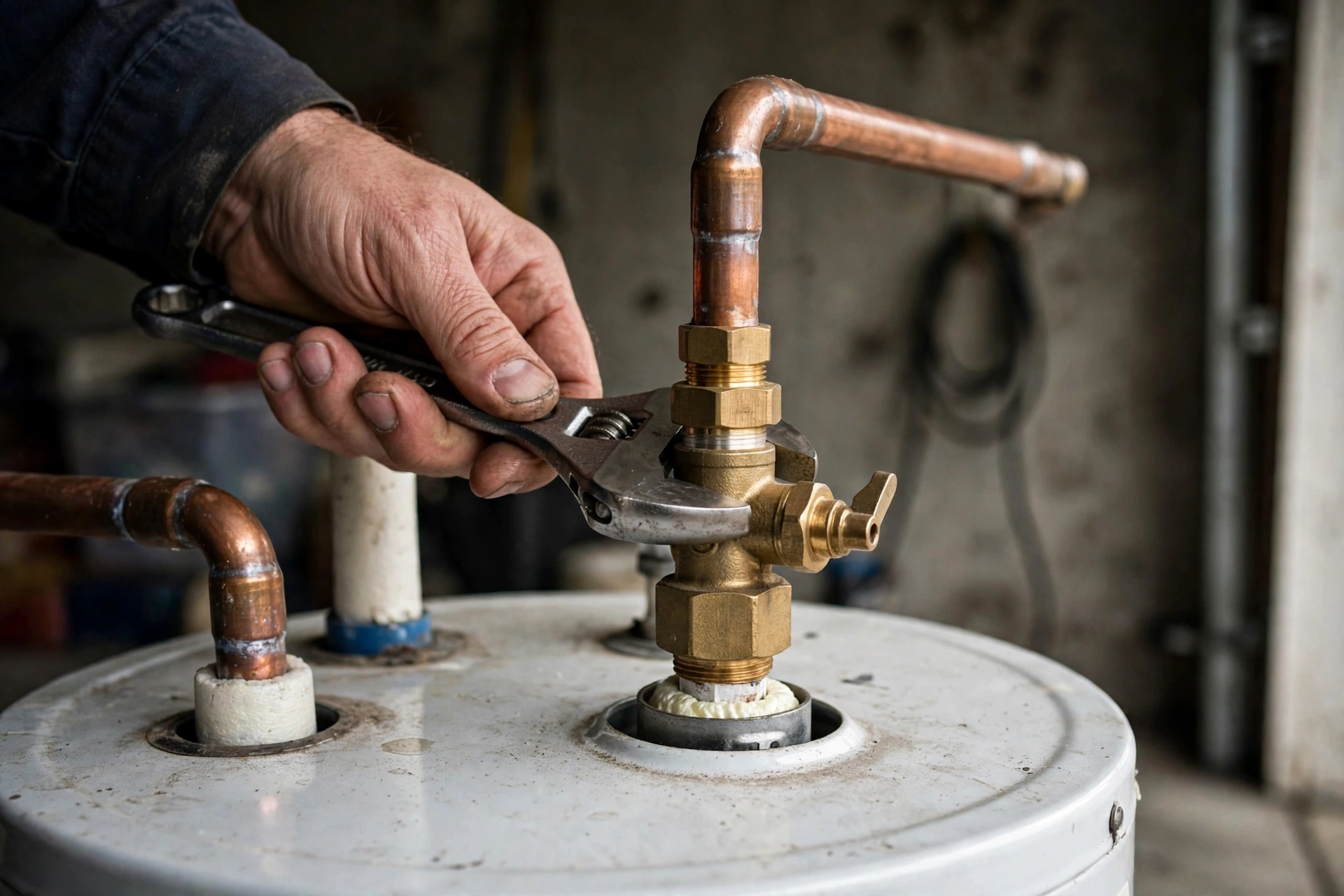
Steady dripping from the discharge pipe
Water steadily dripping or trickling from the end of the discharge pipe, leaving a puddle or a constantly damp floor beneath it.
Directly: the temperature and pressure relief (TPR) valve is the last line of defense between your water heater and a dangerous overpressure event. If the water inside the tank gets too hot or the pressure climbs beyond safe limits — because a thermostat failed, pressure spiked, or the tank overheated — the valve opens on its own and releases water through the discharge pipe, bringing conditions back into the safe range. Every residential water heater is required to have one, and for good reason: without a working relief valve, a runaway tank becomes a pressure vessel.
In normal operation you should never see a drop of water from it. The TPR valve is a small brass device, usually mounted near the top of the tank, with a little metal lever and a pipe — the discharge pipe — running from it down toward the floor. It sits closed and silent for years. A valve that is dripping is either failing, or it is actively protecting you from unsafe pressure. Both situations call for a professional diagnosis.
Any of these signs means the valve — or the pressure behind it — needs a professional look right away.
Water steadily dripping or trickling from the end of the discharge pipe, leaving a puddle or a constantly damp floor beneath it.
The discharge pipe outlet stays damp even when nobody has used hot water for hours — a sign of a worn valve or steady high pressure.
You lifted the small test lever and the valve never fully closed again. Water keeps flowing — the seal did not survive the test.
Brief hissing, spitting, or bursts of hot water from the pipe, often right after the burner or elements finish a heating cycle.
White or greenish crust and corrosion around the valve body — evidence it has been weeping slowly, perhaps for months.
A valve that has sat for years without ever opening may be seized shut — and a seized valve cannot protect you in an emergency.
It usually comes down to two stories: either the valve itself has worn out, or the valve is working exactly as designed and telling you the system pressure is too high. The repair is completely different in each case, which is why a real diagnostic comes before any wrench turns.
Our repair visit starts by finding out which of these is true, because replacing a good valve while the pressure problem remains changes nothing.
Yes — treat every drip as a warning, not a nuisance. If the drip means the valve is doing its job, then something is pushing your tank’s temperature or pressure beyond safe limits, and that condition is the hazard. If the valve itself is failing, your water heater’s last line of defense is compromised — a valve that cannot open on demand cannot save the tank in a real emergency.
Critical safety rules every homeowner should know:
You can learn a lot just by looking — no tools, no dismantling, and no touching the valve itself.
What you should never do: remove, cap, plug, or adjust the valve yourself. It threads into a pressurized fitting at scalding temperature, and a mistake here has real consequences. Look, note what you see, and let a professional handle the rest.
Diagnosis first, valve replacement second — here is exactly what happens when we come out:
Test the system pressure
We measure static pressure and watch it through a full heating cycle, so we know whether pressure — not the valve — is the real problem.
Check for a closed loop and thermal expansion
We look for a check valve or pressure-reducing valve on the main line and test the expansion tank’s air charge and bladder — the most common hidden cause of chronic dripping.
Verify the thermostat
We confirm the water temperature is not running excessively hot, which would point to a failing gas control or electric thermostat rather than the valve.
Replace the valve with the correct rating
If the valve has failed, we install a new brass TPR valve matched to your tank’s temperature and pressure rating — correct thread sealant, correct torque, no shortcuts.
Verify the discharge piping
We confirm the discharge pipe is full-size, unobstructed, uncapped, and terminates safely near the floor.
Confirm it seats and stays dry
We run the tank through a heating cycle and verify the new valve seats properly with zero dripping, then re-check pressure to confirm the cause is resolved.
Because the old valve was the messenger, not the problem. In a closed-loop home — common across Lynnwood where pressure-reducing valves sit on the main — every heating cycle raises system pressure, and a brand-new valve will weep just like the old one until that expansion is handled.
That is why we fix the cause, not just the symptom. If your expansion tank has a ruptured bladder or has lost its air charge, we service the expansion side of the system so the new valve can do its job: sit closed and silent until a real emergency. Learn more about expansion tank repair and how it connects to relief-valve dripping.
Barely. The TPR valve is a universal safety part, not a brand-specific one — we service valves on Rheem, AO Smith, Bradford White, State, Kenmore, Whirlpool, and other major brands with the same process. What matters is the correct temperature and pressure rating for your particular tank and a proper installation, not the logo on the front.
Gas or electric does not change the valve either, though the checks around it differ: gas controls and thermostats on a gas unit, upper and lower thermostats and elements on an electric one.
Here is our honest guidance: a TPR valve repair makes sense when the tank is otherwise sound. But if the tank is rusting, leaking from the tank body itself, or producing rusty water, a new valve will not save it — the tank is failing, and no valve repair changes that. We will tell you straight which situation you are in.
One more honest note: sometimes what looks like a “TPR valve leak” is actually water escaping from a fitting above and running down the discharge pipe. We trace every leak to its true source before recommending anything — if the real problem is a leaking tank or fitting, we will show you and point you to the right fix. Compare your options in our repair vs. replace guide.
A few habits keep the TPR valve ready for the day it matters:
Everywhere in our service area — from Alderwood Manor and Lynnwood City Center to Meadowdale, Martha Lake, North Lynnwood, and Lake Serene. We see TPR valve trouble in older tanks with original valves well past their prime, and in newer closed-loop plumbing where a pressure-reducing valve on the main makes thermal expansion a regular visitor.
If your valve is dripping, stuck, or discharging right now, do not wait on it — this is one repair where delay has a safety dimension. Call The Heater Medics at 8665723596. We are available Mon–Fri 7AM–7PM and Sat 8AM–4PM, with 24/7 emergency service for urgent situations like a continuously discharging valve.
Real answers to the questions we hear most often from local homeowners and property managers.
A failed expansion tank is the most common reason a new TPR valve keeps dripping. We diagnose and repair the expansion side of your system.
View Expansion Tank RepairNot every drip near the valve is the valve. We trace every leak to its true source — tank, fitting, or relief valve — and fix the right thing.
View Leaking Water Heater RepairEvery TPR valve visit starts with a full system diagnosis: pressure, expansion, and thermostat checks before any repair is recommended.
View Water Heater DiagnosticFor reliable water heater repair services in Lynnwood, reach out to us. We are available 24/7 for your convenience and respond quickly to all inquiries.
Call now for same-day service
Talk directly to a water heater pro — no waiting on hold. 24/7 emergency service available.
8665723596Phone
8665723596Address
2250 186th St SW #109, Lynnwood, WA 98037, USA
Hours
Mon–Fri: 7AM – 7PM
Sat: 8AM – 4PM
Sun: Emergency Only
24/7 Emergency Available