The Heater Medics
Get Estimate
Browse Services
Service Areas
Call 8665723596

Tankless Water Heater Error Codes Troubleshooting in Lynnwood, WA

Tankless diagnostics & code repairs


That blinking code on your tankless unit is the unit telling you exactly what is wrong. We read, diagnose, and repair the underlying fault behind Rinnai, Navien, Noritz, and Rheem error codes across Lynnwood.

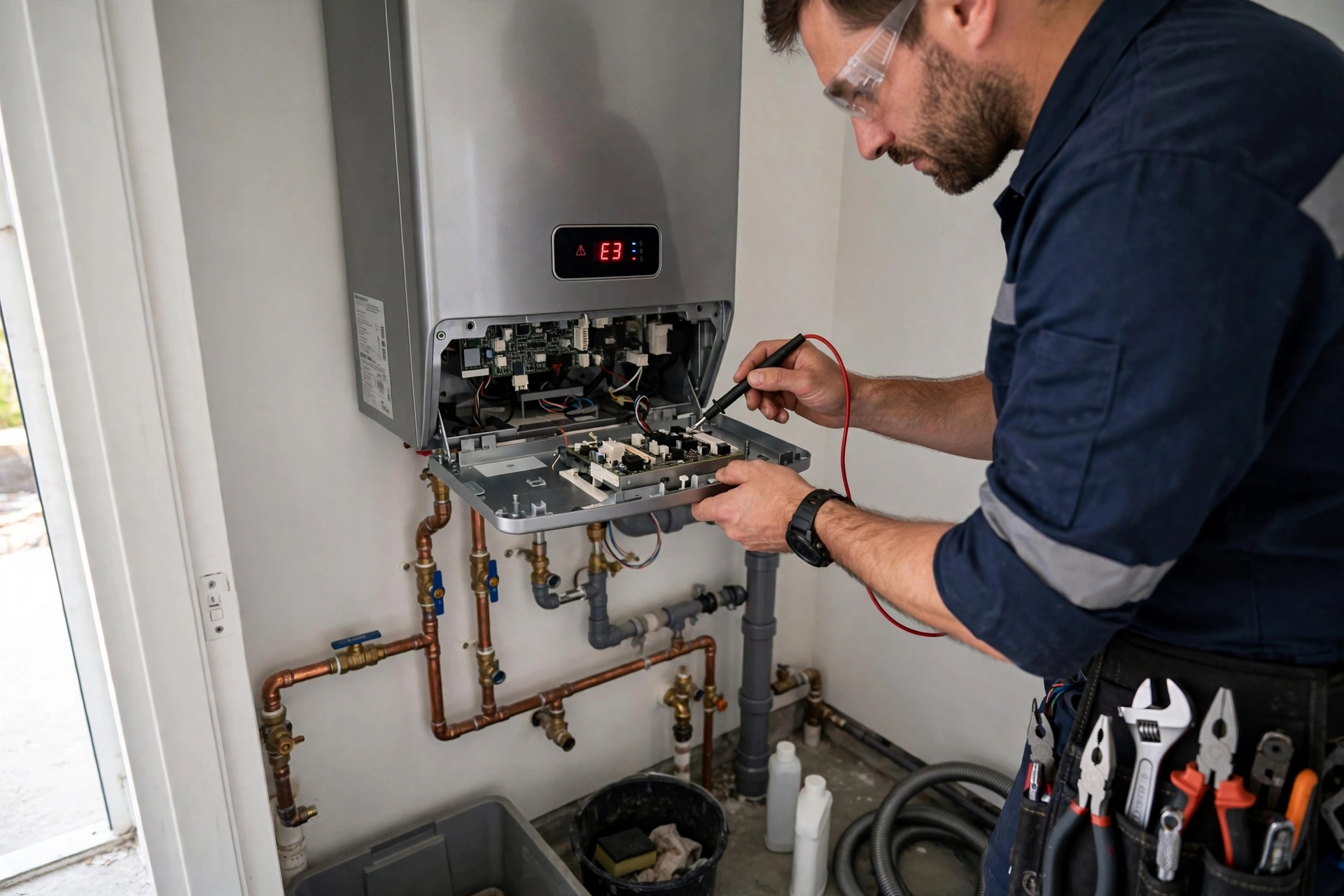
Wall-mounted tankless water heater with a digital display showing an error code as a technician diagnoses it in Lynnwood
Licensed Licensed & Bonded
Fully Insured Insured & Bonded
24/7 Emergency Same-Day Response
Warranty Backed 11+ Years Trusted in Lynnwood

What is my tankless water heater trying to tell me when it shows an error code?


A tankless water heater is constantly watching itself. The control board monitors flame presence, water temperature, exhaust pressure, fan speed, and gas flow many times per second. When any reading moves outside a safe range, the board shuts the burner down and displays a code instead of letting the unit keep running in an unsafe condition.

That lockout is a safety feature, not a failure of the feature. The code you see — a two-digit number, a letter-plus-number combination, or a pattern of blinking lights depending on the brand — points to the family of the fault: ignition, flame, temperature, venting, water flow, or gas supply. It does not name the broken part. An ignition code can mean a dirty flame rod, a weak igniter, a gas interruption, or a draft issue — and finding the real cause is where diagnosis earns its keep.

Seeing a tankless error code in Lynnwood? tankless water heater repair starts with reading that code correctly and then testing the system behind it.

What can I safely do at home when a tankless error code appears?


Before you call, there are a few safe checks any homeowner can do resolve many nuisance lockouts — and give us useful information if the code returns:

  • Power-cycle the unit. Switch the unit off at its power switch or the breaker, wait a full 30 to 60 seconds, then restore power — this clears transient faults the way restarting clears a glitch in any computer.
  • Check your other gas appliances. If the stove or furnace also misbehaves, the problem is the gas supply to the house, not the water heater — and that is utility territory, not ours.
  • Confirm water and power are on. A closed water valve, a tripped breaker, or a GFCI outlet that has popped will each shut a tankless unit down.
  • Look at the vent termination from outside. Walk around the house and check the vent pipe outlet for snow, ice, leaves, bird nests, or debris. Do not disassemble anything — just look and, if you can do it safely from the ground, clear what is blocking it.

If the code clears and stays cleared, you were likely dealing with a transient glitch or a blocked vent. If it returns — even hours later — write down the exact code and call us at 8665723596. A recurring code always has a real cause behind it.

What should I never do when my tankless unit throws an error code?


A tankless unit combines gas combustion, high-voltage ignition, and sealed venting in one cabinet. The line between a safe homeowner check and a dangerous one one you should not cross:

  • Do not open the cabinet. The sealed combustion chamber, electrical components, and gas train are not homeowner-serviceable. Opening the unit also breaks the venting seals that keep exhaust out of your home.
  • Do not touch gas components. Never adjust the gas valve, regulator, or gas line fittings, and never try to relight anything manually.
  • Do not bypass sensors or reset the unit repeatedly. Safety sensors locked the unit out for a reason. Bypassing them or power-cycling over and over to force hot water can turn a small fault into a dangerous one.
  • Do not ignore a gas smell or a carbon monoxide alarm. Leave the house, and call your gas utility or emergency services from outside before you call us.

What are the most common tankless error-code families in Lynnwood?


Every brand numbers its codes differently, but the faults behind them fall into the same families — what each means, what usually causes it, and what our repair involves.

Ignition and flame failure

The burner fails to light or the flame drops out — the most common fault family of all. Widely documented examples: Rinnai 11 and 12, Navien E003 and E012, Noritz 11 and 12, and Rheem tankless 11 and 12. Causes range from gas interruptions and dirty burners to failing igniters and draft problems. Our repair: test inlet gas pressure, inspect and clean the igniter and burner, and verify venting draft.

Overheating and high-limit faults

The heat exchanger gets hotter than its safe limit and the board shuts everything down. Common triggers are mineral scale inside the exchanger, restricted water flow, or a recirculation problem. Our repair: descale the heat exchanger, test the flow sensor and limit switches, and confirm stable temperatures under load.

Venting and exhaust faults

The unit cannot breathe or exhale properly — a blocked vent termination, a leaking vent joint, a clogged condensate drain on a condensing model, or an intake restriction. Pressure switches detect it and lock the burner out. Our repair: inspect the full vent run, check termination clearances, clear the condensate path, and verify seals and pressure switches.

Scale and mineral buildup

Hard-water minerals coat the inside of the heat exchanger, narrowing the water passages. The unit overheats in spots, flow drops, and overheat or flow codes follow. Our repair: when scale is the cause, descaling the heat exchanger is part of the repair itself — not a maintenance plan, but the fix the code demands, since it will keep returning until the scale is gone.

Sensor and flame-rod faults

Temperature sensors drift out of calibration, flame rods get coated with carbon, and wiring connections corrode. The board then acts on bad data — shutting down a healthy burner or missing a real fault. Our repair: clean or replace the faulty sensor, verify readings against real temperatures, and check the wiring harness.

Gas supply and airflow faults

An undersized gas line starves the burner when demand peaks, inlet pressure sags, the combustion fan wears out, or the air intake filter clogs. The flame goes unstable and the board locks out. Our repair: measure gas pressure under full firing load, test the fan, clean the intake, and trace the fault to the supply side or the unit.

Do different brands show different error codes?


Yes — each manufacturer has its own code list, but the faults underneath are the same. Rinnai, Navien, Noritz, and Rheem tankless units are the brands we see most often in Lynnwood homes, and our technicians work from each brand's documented diagnostic procedures rather than guessing. A Rinnai 12, a Navien E003, a Noritz 11, and a Rheem 11 all point at ignition or flame problems, but each brand's documented service sequence for confirming the cause is different — and following the right one is what separates diagnosis from parts-swapping.

If your unit is one of these brands, you can read more about how we service each one: Rinnai water heater repair, Navien water heater repair, and Noritz water heater repair. Whatever the brand, every code repair starts with a proper water heater diagnostic so we fix the cause, not just the code.

How does scale and mineral buildup cause tankless error codes?


Tankless units heat water in a compact heat exchanger with narrow passages, so even a thin layer of mineral scale changes how the unit behaves. Scale insulates the metal from the water: the burner side runs hotter than the sensors expect while the water side underperforms, and the board responds with overheat or flow-related codes.

Here the repair and the cure are the same job: the heat exchanger must be descaled for the codes to stop. When our diagnostic finds scale behind the fault, descaling is part of the repair we perform — not a separate maintenance plan we try to sell you. We clear the buildup, verify flow and temperature readings return to normal, and confirm the code stays gone under real hot-water demand.

What happens when you call us for a tankless error code?


Every error-code visit follows the same disciplined sequence — nothing guessed at, nothing replaced without proof:

01

Read and record the code

We document the exact code, how often it appears, and what the unit was doing when it locked out — your notes help enormously.

02

Test the system behind it

Gas pressure under load, sensor readings, vent pressures, water flow, and electrical checks — we measure rather than assume.

03

Repair the actual fault

We repair the failed component — igniter, sensor, fan, valve, or scaled heat exchanger — fixing the cause behind the code.

04

Verify under real demand

We run the unit through full hot-water demand and confirm the code stays cleared before the job is done.

What should I do if I smell gas or the carbon monoxide alarm goes off?


Treat this as an emergency, not a repair call. If you smell gas — the rotten-egg odor added to natural gas — or your carbon monoxide alarm sounds, get everyone out of the house immediately. Do not flip light switches, do not unplug anything, and do not go back inside to open windows. Call your gas utility or 911 from outside the home.

Carbon monoxide is odorless and colorless, which is why a cracked heat exchanger or compromised vent is so serious: exhaust meant for the vent can spill into living spaces. Once the utility or fire department clears the home as safe, call us at 8665723596 — our 24/7 emergency line — and we will inspect the unit, the venting integrity, and the combustion system to find and repair the source. If you have gas water heater concerns of any kind, never wait on them.

Can an error code mean my tankless unit is finished?


Sometimes, and we will tell you honestly when that is the case. Most error codes trace back to fixable faults — a fouled flame rod, a drifting sensor, a blocked vent, scale in the exchanger — and repairing the component puts the unit back in service. But repeated control-board failures, or a failed heat exchanger on an older unit, are faults where more repair work is not in your interest, and we will say so plainly rather than sell you another visit.

We are a repair-only company — we do not sell installations — so our advice has no upsell behind it. If you are weighing the decision, our repair vs. replace guide walks through how to think about it, and we will give you a straight assessment on site.

Do you troubleshoot tankless error codes throughout Lynnwood?


Yes. The Heater Medics diagnoses and repairs tankless error codes in homes and condos across Lynnwood, WA — including Alderwood Manor, Lynnwood City Center, Meadowdale, Martha Lake, North Lynnwood, and Lake Serene. We carry the diagnostic equipment and brand-specific knowledge to read tankless codes correctly on the first visit.

We are available Mon–Fri 7AM–7PM and Sat 8AM–4PM, with 24/7 emergency service for lockouts that leave you without hot water. If your tankless unit is flashing a code right now, call 8665723596 — tell us the code, and we will take it from there.

Frequently Asked Questions

Real answers to the questions we hear most often from local homeowners and property managers.

Can I reset the error code myself?
Yes — the safe version is a single power-cycle: switch the unit off at its power switch or breaker, wait 30 to 60 seconds, then restore power. That clears transient glitches. Do not open the cabinet, touch gas components, or bypass a sensor. If the code comes back after your reset, stop resetting and call a technician — a recurring code always has a real fault behind it.
Will the code come back after a reset?
Often, yes. A reset clears the lockout but does nothing about the cause — a fouled flame rod, a drifting sensor, scale in the heat exchanger, or a vent restriction is still there. If the code returns, even hours or days later, that is the unit telling you the fault is real and persistent. Note the exact code and call us at 8665723596 so we can diagnose the cause instead of chasing the symptom.
What do Rinnai error codes 11 and 12 mean?
Rinnai codes 11 and 12 are ignition and flame-failure codes: 11 means the unit failed to ignite, and 12 means the flame was lost during operation. Common causes include a gas supply interruption, a dirty burner, a failing igniter, or a draft issue. We test inlet gas pressure, inspect and clean the igniter and burner assembly, check the flame rod, and verify proper venting.
Is it safe to keep using hot water with an error code showing?
No. The lockout exists because the control board decided it was not safe or reliable to keep firing the burner. Repeatedly resetting it can turn a minor sensor fault into overheating or mask a venting problem that spills exhaust indoors. If a lockout leaves you without hot water, call our 24/7 emergency line at 8665723596 rather than forcing the unit to run.
Do error codes always mean a part is broken?
Not always. The code names the family of the fault, not the broken part. Sometimes the cause is simple — a blocked vent termination outside, a tripped breaker, or a transient glitch that a single reset clears for good. Other times a sensor, igniter, fan, or gas valve has genuinely failed, or scale has built up in the heat exchanger. That is why our visit starts with testing the system behind the code — gas pressure, sensor readings, and vent pressures — so we repair the actual cause.
How long does a tankless error-code repair take?
Most are completed in a single visit. Once we read the code and run our tests, common faults — a fouled flame rod, failed igniter, bad sensor, or blocked vent — are repaired on the spot, and we verify the code stays cleared under full hot-water demand before leaving. If a part must be ordered, we will tell you exactly what is wrong and what comes next — no guessing.
My unit shows a code sometimes but still makes hot water — what is going on?
That usually means the fault is intermittent — a gas-pressure dip that only happens when another appliance fires simultaneously, or a sensor that drifts only when the unit is fully hot. Intermittent faults need proper diagnostic testing rather than another reset, because they tend to get worse. Note the code and when it appears, then call 8665723596.

Water Heater Emergency Right Now?

Don't wait for the damage to spread. Call now — a real person answers 24/7, and we'll have a truck rolling to anywhere in Lynnwood fast.

Call Now Get a Quote

Contact Us for Water Heater Repair

For reliable water heater repair services in Lynnwood, reach out to us. We are available 24/7 for your convenience and respond quickly to all inquiries.

Call now for same-day service

Talk directly to a water heater pro — no waiting on hold. 24/7 emergency service available.

8665723596

The Heater Medics


  • Phone

    8665723596
  • Address

    2250 186th St SW #109, Lynnwood, WA 98037, USA

  • Hours

    Mon–Fri: 7AM – 7PM
    Sat: 8AM – 4PM
    Sun: Emergency Only
    24/7 Emergency Available

Call 8665723596 Get Quote
Call Quote