
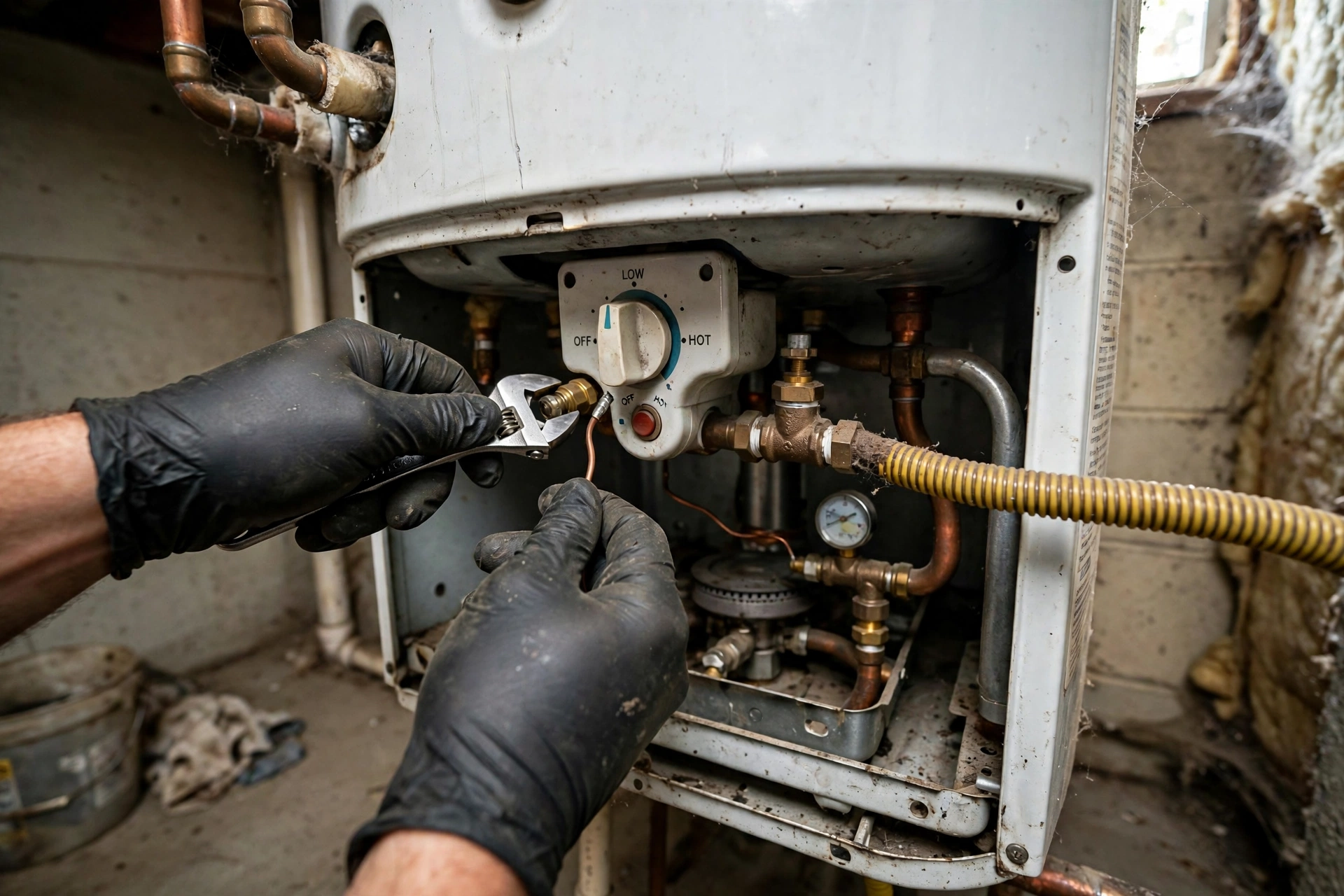
Pilot will not light at all
No flame, no click, no response. This can mean a blocked pilot orifice, an interrupted gas supply, or a gas control valve that has failed internally and will not open the pilot gas passage.
The thermocouple is your water heater’s flame sensor and its most important gas-safety device. It is a small metal probe that sits directly in the pilot flame. When the flame heats it, the thermocouple generates a tiny electric current, and that current is what holds the pilot gas valve open. If the pilot flame goes out, the thermocouple cools, the current stops, and the valve snaps shut, cutting the gas supply. That single mechanism is what keeps raw gas from flowing into your home when there is no flame to burn it.
Some units use a close cousin called a thermopile instead. A thermopile is essentially several thermocouple junctions joined together, producing enough power to operate the gas valve on its own. The principle is identical: no heat on the sensor, no gas flow. A weakened or sooty sensor can no longer generate enough current, so the pilot refuses to stay lit. Thermocouple diagnosis is the starting point for much of our gas water heater repair work in Lynnwood.
If your heater is doing any of these, the thermocouple, pilot assembly, or gas control valve is the prime suspect.
No flame, no click, no response. This can mean a blocked pilot orifice, an interrupted gas supply, or a gas control valve that has failed internally and will not open the pilot gas passage.
The classic failing-thermocouple symptom. The pilot burns while you hold the knob because you are overriding the safety circuit; release it, and a weak thermocouple cannot generate enough current to hold the valve open.
When the sensor is doing its job yet the main burner will not ignite, the fault usually sits in the gas control valve itself — a failed thermostat section, a stuck valve, or an electrical fault in the valve body.
A rotten-egg odor around the valve can mean a leak at a seal, connection, or the valve body. Do not investigate it yourself — leave the area and call your gas utility’s emergency line first, then call us.
The temperature dial is part of the gas control valve. When water swings to extremes or the burner cycles strangely, the valve’s thermostat section is often failing — a safety issue, not just a comfort one.
A healthy pilot is a steady blue flame fully engulfing the thermocouple tip. A small, wavering, or yellow flame — often from a dirty orifice or low gas supply — cannot heat the tip enough to keep the safety circuit closed.
The gas control valve is the box mounted on the side of the tank where the gas line connects. It performs three jobs at once: it feeds gas to the pilot light, opens gas to the main burner whenever the thermostat calls for heat, and it shuts everything down the instant the thermocouple reports no flame. The temperature dial on the front of the unit is part of this same valve, so when your water runs scalding hot or never gets warm, the valve’s thermostat section is often the culprit rather than the burner itself.
Valves fail in a few distinct ways. Internal seals can wear and weep gas. The thermostat can drift, overheating the water or refusing to fire the burner. The pilot gas passage can clog with debris. And the electrical connection where the thermocouple screws in can corrode, breaking the safety circuit even though the sensor itself is fine. Most residential tanks in Lynnwood use valves from Honeywell, Robertshaw, or White-Rodgers, fitted by brands like Rheem, AO Smith, Bradford White, and State. Valves are model-specific: the replacement must match the original in gas type, capacity, and thread size. We service these valves across all major brands — see our dedicated Rheem water heater repair page for an example of our brand-specific approach.
In most Lynnwood homes we visit, the cause is one of these:
Each cause needs a different fix — cleaning a sooty tip, replacing a worn sensor, clearing an orifice, or replacing a failed valve are very different jobs. That is why we test rather than guess, and why a pilot light that keeps going out deserves a proper diagnosis instead of repeated relighting attempts.
Treat any gas smell as an emergency. Do not try to find the source, do not relight the pilot, and do not flip any electrical switches or use your phone inside the house — a spark can ignite accumulated gas. Leave the building immediately, From a safe place outside, call your gas utility’s emergency line first. Once the utility has responded and the area is declared safe, call us at 8665723596 and we will come inspect the valve and every connection.
Carbon monoxide is a separate, silent danger. A malfunctioning gas valve or a blocked vent can produce carbon monoxide, which you cannot see or smell. Every home with a gas water heater should have a working CO detector nearby. If the detector alarms, or if anyone near the unit develops headaches, dizziness, or nausea, get into fresh air immediately and call 911.
If there is no gas smell, there are two checks you can safely do yourself. First, try relighting the pilot exactly once, following the lighting instructions printed on the unit’s label. Second, check your other gas appliances: if the stove and furnace are working normally, the gas supply is fine and the problem is in the heater. If the pilot still will not stay lit after one careful attempt, stop there. Repeated relighting with a failing safety component is not safe — that is the point to call a technician.
A safe, methodical sequence: the gas is off before anything is touched.
Gas shutoff and safety check
We shut off the gas at the unit, make sure the area is ventilated, and inspect the valve, pilot assembly, and venting before touching anything.
Millivolt test of the thermocouple
We measure the thermocouple’s electrical output with a meter, which tells us in seconds whether the sensor is weak or the valve is at fault — no guesswork, no unnecessary parts.
Clean or replace the thermocouple and pilot
If the pilot orifice is blocked, we clean it. If the thermocouple is worn, sooty, or damaged, we replace the thermocouple or the full pilot assembly with the correct part for your unit.
Gas valve diagnosis
If the sensor tests good but the burner still will not fire or the thermostat misbehaves, we diagnose the gas control valve itself, including its electrical connections and gas passages.
Correct-model valve replacement
A faulty valve is replaced with the exact model specified for your tank — matching brand, gas type, and capacity — never a close-enough substitute.
Leak test and burner verification
Every connection is leak-tested, the pilot is relit, and we verify the burner fires, cycles, and shuts down correctly before we leave.
A thermocouple or pilot assembly replacement is one of the most straightforward repairs in water heating, and it makes sense whenever the tank itself is sound. If the tank is not leaking, not visibly rusted through, and still within its typical service life, fixing the control components restores the heater to normal operation.
It is a different story when the tank shell is compromised. If you see rust streaks running down the jacket, water pooling at the base, or the tank is well past the age most heaters last, a new gas valve will not save a failing tank. We will tell you that honestly before any work begins — if the tank is done, we say so, and we do not sell you a valve repair you do not need. For help thinking through that decision, see our repair vs. replace guide.
You cannot stop a thermocouple from aging, but a few simple habits keep the pilot and gas valve healthier for longer:
The Heater Medics repairs thermocouples, pilot assemblies, and gas control valves throughout Lynnwood — from Alderwood Manor and Lynnwood City Center to Meadowdale, Martha Lake, North Lynnwood, and Lake Serene. A pilot that will not stay lit is one of the most common no-hot-water calls we take.
We are available Mon–Fri 7AM–7PM and Sat 8AM–4PM, with 24/7 emergency service for the nights the pilot dies at the worst possible moment. If you smell gas, follow the safety steps above first. For everything else, call 8665723596 or reach us through our emergency water heater repair line, and we will get your hot water back.
Real answers to the questions we hear most often from local homeowners and property managers.
Full diagnosis and repair of gas water heaters in Lynnwood, from burners and ignition to venting and controls.
View Gas Water Heater RepairA deeper look at why pilots fail and which checks are safe to try yourself before calling a technician.
View Pilot Light Keeps Going Out? Causes & FixesNo hot water at the worst time? 24/7 emergency repair across Lynnwood, WA — call 8665723596.
View Emergency Water Heater RepairFor reliable water heater repair services in Lynnwood, reach out to us. We are available 24/7 for your convenience and respond quickly to all inquiries.
Call now for same-day service
Talk directly to a water heater pro — no waiting on hold. 24/7 emergency service available.
8665723596Phone
8665723596Address
2250 186th St SW #109, Lynnwood, WA 98037, USA
Hours
Mon–Fri: 7AM – 7PM
Sat: 8AM – 4PM
Sun: Emergency Only
24/7 Emergency Available