
Water only gets lukewarm
The shower never gets fully hot no matter how far you turn the tap. This often means the upper thermostat has failed or drifted out of calibration, so the upper element never kicks on properly.
The thermostat is the control center of a standard electric storage water heater. Most electric tanks have two thermostats - an upper thermostat and a lower thermostat - mounted behind access panels on the side of the tank. Each one monitors the temperature of the water in its zone and tells its matching heating element when to switch on and off.
The upper thermostat gets first priority. It heats the top of the tank to the set temperature, then hands off to the lower thermostat, which heats the rest. This sequencing gives you steady hot water through a shower. When either thermostat fails, that sequence breaks down - and the symptoms show up fast at your faucets.
If your water is behaving oddly - lukewarm when it should be hot, scalding when it should be steady, or disappearing halfway through a shower - the thermostat is one of the first things we check during a water heater diagnostic visit. Thermostat faults are common, and most are repairable the same day.
These are the symptoms we see most often in Lynnwood homes when a thermostat starts to fail. If one of them matches what you are experiencing, a thermostat fault is a strong suspect.
The shower never gets fully hot no matter how far you turn the tap. This often means the upper thermostat has failed or drifted out of calibration, so the upper element never kicks on properly.
You get a few minutes of heat, then it goes cold. A failed lower thermostat leaves the bottom of the tank heating on one element - half the tank stays underheated and recovery crawls.
A thermostat stuck in the closed position keeps the element heating without limit. This is the one symptom to act on quickly - overheated water is a scalding hazard and stresses the tank.
The red reset button on the upper thermostat (part of the ECO high-limit switch) cuts power when water overheats. If it trips again after you press it once, something underneath is still wrong.
Both thermostats have failed, the ECO has tripped and stayed tripped, or a wiring fault upstream has cut power to the controls. This needs a full electrical diagnosis before anything else.
Hot, then cold, then hot again during a single shower. A thermostat with worn contacts or a loose wiring connection can cycle erratically instead of holding a steady temperature.
Thermostats wear out: the contacts inside cycle thousands of times and eventually stick, pit, or lose calibration. In many Lynnwood homes the trigger is sediment - hard water deposits settle at the bottom of the tank and bury the lower element, so the lower thermostat keeps calling for heat it cannot satisfy, and the extra cycling shortens its life.
The most common causes we find during electric water heater repairs are:
Two checks are safe for a homeowner. First, check your breaker panel: an electric water heater runs on a dedicated double-pole breaker. If it has tripped, reset it once. If it holds, you may be fine; if it trips again, leave it off and call us - repeated trips point to a short or a failed element, not a nuisance trip.
Second, you can press the red reset button on the upper thermostat - but only once, and only with the breaker ON. Here is the honest read on what happens next: if the heater starts working and stays working, the ECO likely tripped on a one-off overheat and you are fine for now. If it trips again within hours or days, do not keep resetting it. A repeat trip means the upper thermostat is failing to cut power, or an element is grounding out, and continued resetting hides a problem that can overheat the tank. That is when you need a same-day repair visit.
Do not remove access panels, touch wiring, or attempt to adjust or replace thermostats yourself unless you are comfortable working around 240 volts and know how to verify power is truly off. The savings are not worth the shock risk.
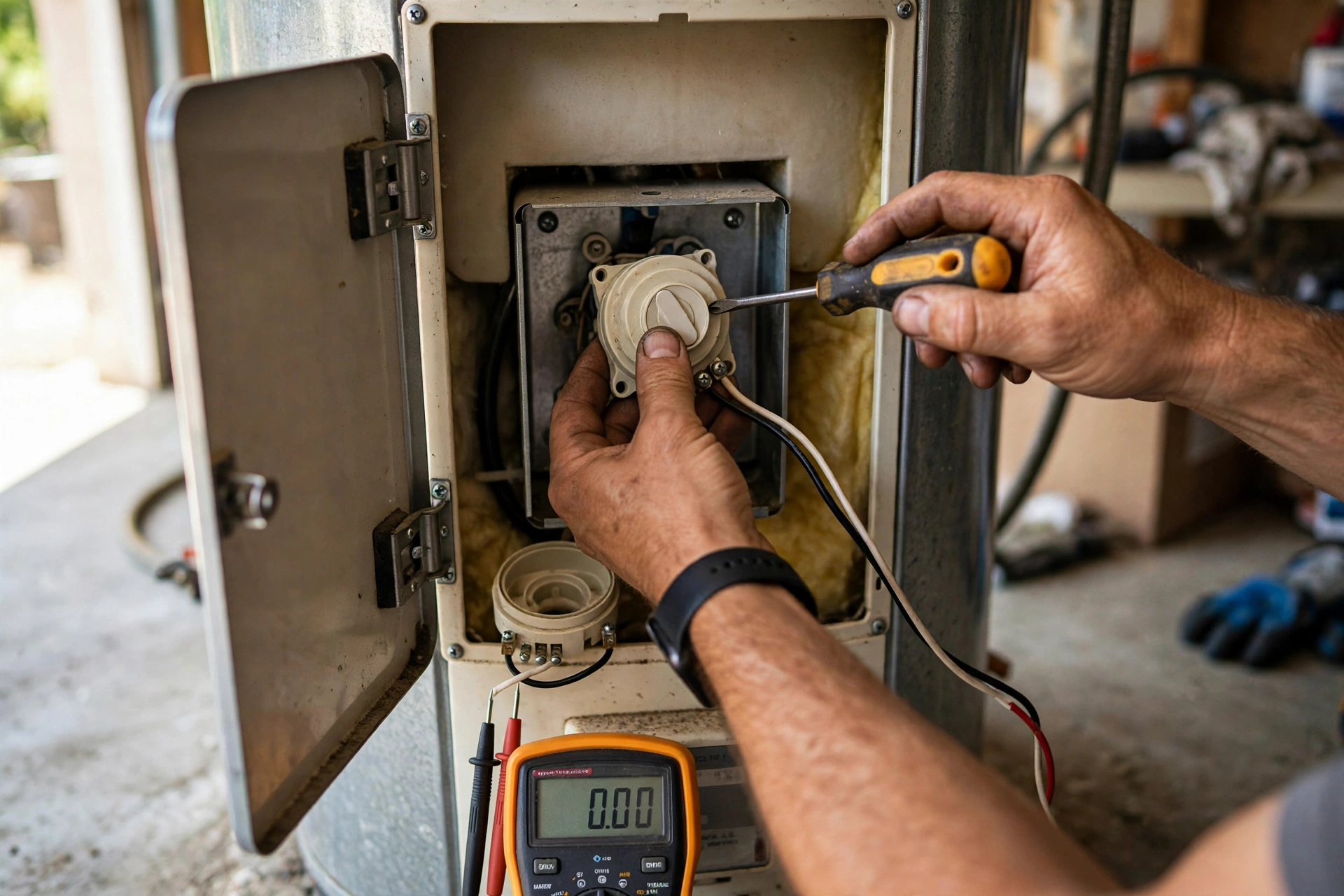
Our thermostat repair follows a fixed sequence: we test first, confirm the failed component, and only then replace it.
Kill the power
We switch off the dedicated double-pole breaker at the panel and verify with a meter that both legs of the 240V circuit are dead before any panel comes off.
Test with a multimeter
We check continuity and calibration on the upper and lower thermostats, the ECO switch, and both elements - so we replace only what actually failed.
Replace the faulty thermostat
We install the correct thermostat model for your unit, re-seat all wiring with clean tight terminals, and check for heat damage at the connections.
Set both thermostats correctly
We set the upper and lower thermostats to the same safe temperature and confirm both agree - mismatched settings cause the uneven heating many people blame on a bad thermostat.
Restore power and verify
We re-energize the circuit, watch the full heating cycle, and confirm the elements switch on and off at the right temperatures before we leave.
If testing shows the tank itself is the problem - a leaking seam, a rusted-out base, or water under the unit - we will tell you straight that no thermostat can fix that. Replacing controls on a dead tank wastes your time and ours.
An electric water heater runs on 240 volts - twice the voltage of a standard outlet, and more than enough to cause a lethal shock. That voltage sits at the thermostat terminals behind the access panels, and the circuit stays live even when the heater is not actively heating. Breakers can be mislabeled, and a double-pole breaker can fail with one leg still hot.
This is why our technicians lock out the breaker and meter-test both legs before touching anything. If you are not trained and equipped to verify a circuit is dead, thermostat replacement is not a DIY job. Pressing the reset button and checking the breaker are the safe homeowner checks - everything behind the access panels belongs to a professional.
The principle is the same across brands - two thermostats, two elements, one high-limit cutoff - but the parts are not interchangeable. Rheem and Ruud units commonly use an upper thermostat with an integrated ECO matched to their element design, while AO Smith and State heaters use their own thermostat profiles with different temperature differentials. Kenmore and Whirlpool tanks follow the same pattern under their own part numbers.
Using the wrong thermostat - one rated for a different wattage or with the wrong temperature swing - causes exactly the symptoms people call us about: short cycling, lukewarm water, or a heater that never quite reaches temperature. We stock the correct thermostats for the brands we see most in Lynnwood, including Rheem and AO Smith units, so the repair is usually finished in a single visit.
Here is our honest guidance. A thermostat repair makes sense when the tank itself is healthy: no leaks, no rust at the base or around fittings, reasonable age, and hot water was fine until the controls started acting up. Thermostats and elements are wear parts; replacing them on a sound tank buys years of normal service and is a straightforward, same-day repair.
A new thermostat will not save a tank that is rusting through, leaking from the shell, or flooding its drain pan. No control repair fixes structural failure - and we will not sell you one if that is what we find. Our repair-versus-replace guide explains how we evaluate tank condition during a diagnostic, so you get a straight recommendation, not a sales pitch.
Thermostats fail less often on tanks that are not fighting sediment. The single best habit is keeping the bottom of the tank flushed of buildup so the lower element and thermostat do not overwork. Beyond that:
Yes. The Heater Medics provides thermostat repair throughout Lynnwood, WA - from Alderwood Manor and Lynnwood City Center to Meadowdale, Martha Lake, North Lynnwood, and Lake Serene. Electric tanks are the most common water heaters here, and thermostat faults are one of our most frequent repairs. We diagnose and repair the controls on site, usually the same day you call. Reach us at 8665723596 - open Mon-Fri 7AM-7PM, Sat 8AM-4PM, with 24/7 emergency service for urgent situations like scalding water.
Real answers to the questions we hear most often from local homeowners and property managers.
Full electrical repairs for tank water heaters in Lynnwood, from elements to controls.
View Electric Water Heater RepairLost hot water entirely? We trace the cause and restore heat the same day.
View No Hot Water RepairMultimeter testing that pinpoints the failed part before anything is replaced.
View Water Heater Diagnostic LynnwoodFor reliable water heater repair services in Lynnwood, reach out to us. We are available 24/7 for your convenience and respond quickly to all inquiries.
Call now for same-day service
Talk directly to a water heater pro — no waiting on hold. 24/7 emergency service available.
8665723596Phone
8665723596Address
2250 186th St SW #109, Lynnwood, WA 98037, USA
Hours
Mon–Fri: 7AM – 7PM
Sat: 8AM – 4PM
Sun: Emergency Only
24/7 Emergency Available