
No hot water at all
The most telling sign. When the upper element fails, the heating sequence never starts, so every tap runs cold even though the breaker is on.
An electric water heater has two heating elements, one near the top of the tank and one near the bottom — like two coils in an electric kettle, each controlled by its own thermostat. They work in sequence: when cold water rushes in, the upper element heats first so you get hot water again quickly. Once the top of the tank is back up to temperature, power switches to the lower element, which heats the bulk of the water. Only one element runs at a time.
That sequence explains every common symptom. A failed upper element means almost no hot water at all, because the lower element never gets its turn. A failed lower element gives you a short burst of hot water that runs out fast. An element is simply a metal sheath containing a coil that heats the surrounding water; when the coil breaks, the element has to be swapped out. That swap is a standard part of electric water heater repair, and one of the jobs we do most in Lynnwood.
Elements rarely die quietly. Here is what a failing or failed element looks like from the homeowner's side:
The most telling sign. When the upper element fails, the heating sequence never starts, so every tap runs cold even though the breaker is on.
A failed lower element is the usual cause. The top of the tank heats normally, giving you a few hot minutes, then the tank can't keep up.
One working element struggling on its own can't bring a full tank to set temperature. The water stays warm but never hot.
An element that has split open or shorted to ground draws far more current than it should. The breaker trips — and will keep tripping until the bad element is removed.
That noise is water boiling beneath sediment that has buried the lower element. The element still works, but it is overheating itself under the mineral crust.
With half your heating capacity gone, the tank takes far longer to recover after laundry or back-to-back showers.
A few of these symptoms overlap with thermostat and wiring problems, which is why we test before we touch. If you are staring at cold taps right now, our no hot water repair visit starts with a proper diagnosis so you only pay for the repair you actually need.
Elements are wear items — every one eventually burns out. Most premature failures trace back to a handful of causes we see again and again in Lynnwood homes:
Yes — one thing. Go to your breaker panel and look for the water heater breaker, usually a double-pole breaker labeled "water heater." If it has tripped, reset it once. If it trips again, leave it off and call us. A breaker that will not stay on is protecting you from a short.
That is where DIY should stop, because the inside of an electric water heater carries 240 volts — enough to injure or kill. And one rule every homeowner in Lynnwood should memorize: never restore power to a drained or partially drained electric tank. Dry-firing destroys heating elements in seconds, so if you have drained your tank for any reason, make sure it is completely refilled — run a hot tap until water flows steadily with no sputtering — before the breaker goes back on. Not sure the tank is full? Keep the breaker off and call us at 8665723596.
Element replacement is a same-day repair. Here is what we do on every job:
Power off, verified dead
We switch the breaker off and meter the wiring at the tank to confirm zero voltage before anything is touched.
Tank drained down
We drain enough water to drop the level below the element being replaced, protecting your floors.
Elements tested, not guessed
Each element is tested with a multimeter for continuity and resistance. We replace only the failed one.
Old element removed
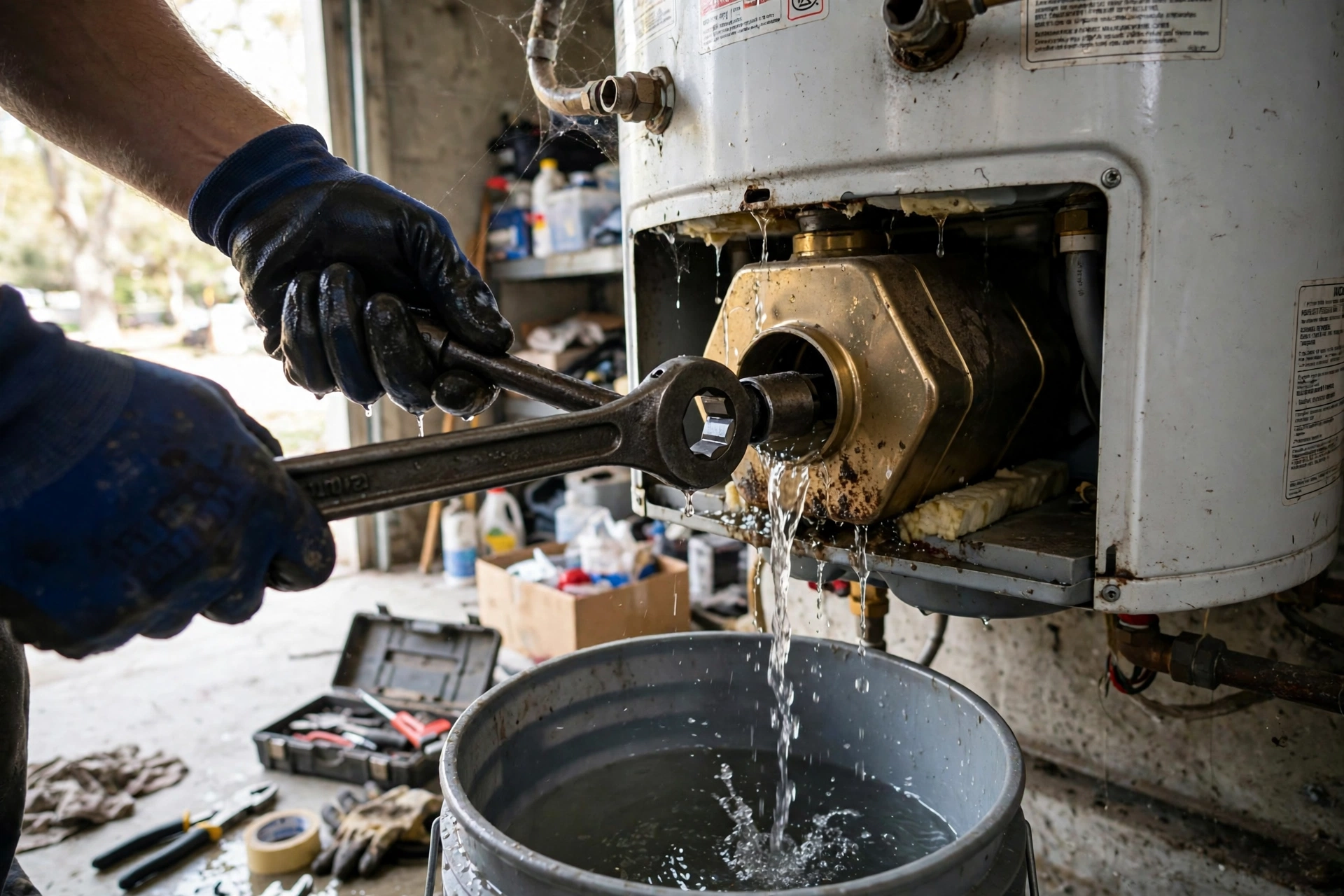
Using a proper element wrench, we back the failed element out — where a corroded element can damage tank threads in unskilled hands.
Correct element installed
The replacement matches your tank's nameplate voltage and wattage exactly, with a fresh gasket, torqued to spec.
Refilled before power returns
The tank is refilled completely and air bled from the lines before the breaker goes back on — the dry-firing rule, every time.
Most element jobs are done in a single visit. If your water heater quit overnight and you need it back today, our 24/7 emergency water heater repair line is open.
No — and installing the wrong one is a common cause of repeat failure. Most modern residential tanks use screw-in elements that thread directly into the tank wall; older tanks and some commercial-style units use flange (bolt-in) elements held in by four bolts. The two are not interchangeable, and the physical size has to suit your tank. Wattage and voltage must match the nameplate — a typical Lynnwood home has a 240-volt tank with 4500-watt elements, but other configurations exist, so we read the nameplate on every job rather than assuming.
Brand notes from the field: Rheem and AO Smith residential tanks overwhelmingly use standard screw-in elements in common wattages; State tanks are similar, with some older models using flange elements. Kenmore and Whirlpool units sold through big-box stores are built by other manufacturers under those names, so we identify the actual platform before choosing the element. Where they fit, we prefer low-watt-density replacements — the same heat spread over more surface area runs cooler and stands up to sediment better. For brand-specific details on the most common platform we see, our Rheem water heater repair page goes deeper.
Honest answer: sometimes a failed element is a symptom, not the whole problem. We will tell you straight when an element repair is not worth it:
The majority of element failures we see are on tanks with plenty of life left, where a proper element replacement returns years of service. We are a repair-only shop — we do not install new water heaters — so when we say a tank should be repaired, you know it is not a sales pitch for an installation. If we believe the tank is done, we will say that too.
Sediment is the enemy. It insulates the lower element from the water it is trying to heat, which means longer firing cycles, hotter element surfaces, and earlier failure. The rumbling and popping some tanks make — the noise behind searches for why a water heater is making noise — is the sound of that process in action.
During a diagnostic visit we check for sediment by listening to the tank, testing recovery behavior, and checking what comes out of the drain valve. After that, the practical steps are simple: always refill the tank completely before restoring power after any drain-down, keep the thermostat at a sensible setting, and call us at the first sign of lukewarm water or slow recovery. Catching a struggling element early is a small repair; ignoring it until the breaker trips is a bigger one.
We repair water heater elements across every Lynnwood neighborhood, with same-day service available in most areas. In Alderwood Manor and North Lynnwood, where many homes still run original mid-2000s electric tanks, sediment-buried lower elements are the failure we see most. Around Lynnwood City Center and the newer builds near Martha Lake, dry-firing after homeowner drain-downs is the more common story. Meadowdale and Lake Serene homes with well-aged tanks often show the classic age pattern — one element down, the other not far behind — which is why we test both and show you the readings. Call 8665723596 and we will get your hot water back the same day.
Real answers to the questions we hear most often from local homeowners and property managers.
Full-service repair for electric tanks: elements, thermostats, wiring, and breakers diagnosed and fixed the same day.
View Electric Water Heater RepairCold taps? We track down the cause — failed element, thermostat, or wiring — and restore hot water fast.
View No Hot Water RepairLukewarm water and short hot-water runs aren't always the element — faulty thermostats cause the same symptoms.
View Water Heater Thermostat RepairFor reliable water heater repair services in Lynnwood, reach out to us. We are available 24/7 for your convenience and respond quickly to all inquiries.
Call now for same-day service
Talk directly to a water heater pro — no waiting on hold. 24/7 emergency service available.
8665723596Phone
8665723596Address
2250 186th St SW #109, Lynnwood, WA 98037, USA
Hours
Mon–Fri: 7AM – 7PM
Sat: 8AM – 4PM
Sun: Emergency Only
24/7 Emergency Available