
Rusty or Discolored Hot Water
When only the hot water runs rusty while the cold stays clear, corrosion is starting inside the tank - often because the rod that was protecting it is gone.
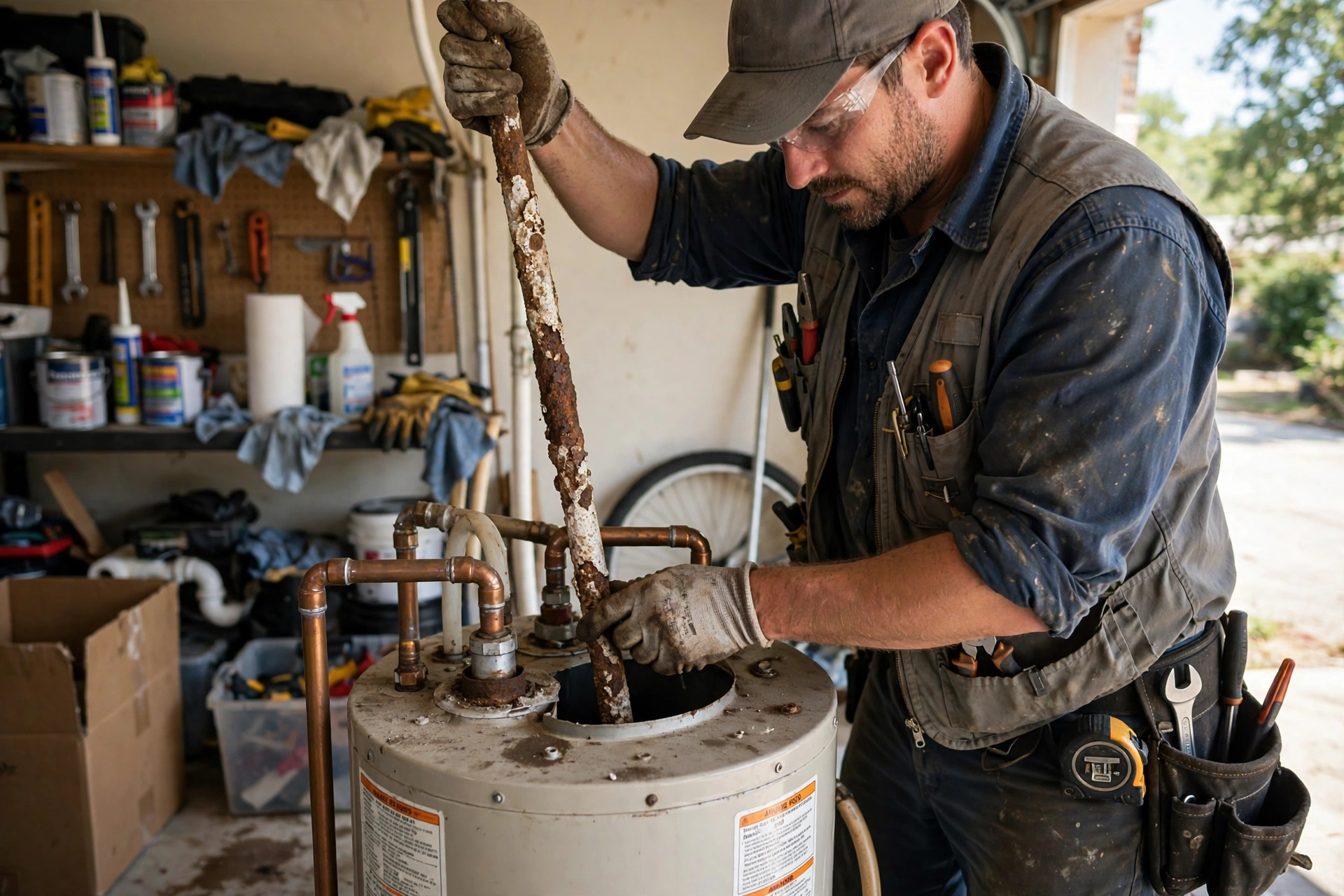
Your water heater's steel tank sits full of hot water all day, every day - and hot water plus steel plus dissolved minerals is a recipe for rust. The anode rod is the tank's bodyguard against that. It is a long metal rod, usually made of magnesium or an aluminum-zinc alloy, threaded into the top of the tank and submerged in the water. Through galvanic corrosion, the rod metal corrodes first, sacrificing itself so the steel tank does not. This sacrificial protection is the main reason a lined steel tank can last for many years instead of rusting through quickly.
The glass lining inside the tank is only a partial shield. It has tiny imperfections from manufacturing, and it wears over time. The anode rod protects exactly those weak spots by drawing corrosion to itself. But the protection is finite. The rod slowly dissolves over the years, and once it is gone, corrosion turns its full attention to the tank itself. That is when rusty water, strange smells, and tank failures begin to show up.
Replacing a spent rod on a still-sound tank restores that protection - which is why we treat anode rod replacement as a genuine repair, not an upsell. And if your tank is already showing signs of trouble, a professional water heater diagnostic can confirm whether the rod is the culprit before any work begins.
These are the symptoms that point most directly at a depleted anode rod. Any one of them is a good reason to have the rod inspected.
When only the hot water runs rusty while the cold stays clear, corrosion is starting inside the tank - often because the rod that was protecting it is gone.
A sulfur or rotten-egg odor that appears in hot water but not cold usually traces back to reactions involving a depleted rod. Switching rod type often calms it.
Noise alone is usually sediment, but a tank that has been rumbling for years has often been working with a dead rod too - the two problems travel together.
Not all anode rods are the same, and the right choice depends on your water and your symptoms. Magnesium rods are the standard choice: they provide strong sacrificial protection and suit most tanks. Aluminum-zinc alloy rods provide slightly gentler protection but have a real advantage for households fighting sulfur smells - the alloy reacts less with water chemistry that produces that rotten-egg odor, so switching from magnesium to aluminum-zinc often calms the smell noticeably.
There are also powered (impressed-current) anodes, which use a small electrical current instead of dissolving metal. They never need replacing, but they cost more up front and need a nearby outlet. We are happy to discuss whether one makes sense for your situation - it is an honest conversation, not a default recommendation.
One more detail matters: some models use a combination anode rod built into the hot-water outlet nipple. If yours does, it takes a specific replacement, and the rod must be the correct length and diameter for your tank. We match the rod to the exact model, so the new rod protects the whole tank rather than just part of it.
A rod's lifespan is not fixed - local conditions can cut it short. Homes with water softeners tend to go through rods faster, because softened water is more conductive and drives the sacrificial reaction harder. High temperature settings speed depletion too, since heat accelerates the chemistry. Aggressive or mineral-heavy water chemistry plays a role as well, and of course plain age: a rod in a ten-year-old tank that has never been checked is very likely gone.
The practical takeaway is simple. If your home has softened water, runs the heater hot, or the tank is getting older, the rod deserves an earlier look. Catching a spent rod while the tank is still sound is the difference between a straightforward repair and a tank replacement down the road.
Replacing an anode rod is precise work - a snapped or cross-threaded rod creates a bigger problem than it solves. Here is how we do it:
Safe Power and Gas Shutoff
We shut off the electrical breaker or gas supply and the cold-water inlet before touching anything, so the work is safe from the start.
Partial Drain-Down
We drain just enough water to drop the level below the rod port - no need to empty the whole tank for this repair.
Extract and Inspect the Old Rod
We break the rod free carefully and pull it for inspection. A rod eaten down to its core wire confirms it was spent.
Choose the Right Replacement
We select the correct type, length, and diameter for your model - including segmented rods where ceiling clearance is tight.
Install and Seal
The new rod goes in with proper thread sealant and correct torque, so it protects the tank and never weeps at the fitting.
Refill and Verify
We refill the tank, restore power or gas, check for leaks, and confirm the water quality issue that brought us out is resolved.
Honesty first: a new anode rod cannot save a tank that is already leaking from corrosion. The rod prevents future corrosion - it cannot reverse steel that has already rusted through. If your tank is leaking from the tank wall or a seam, no rod replacement will fix it, and we will tell you that plainly rather than sell you a repair that cannot work.
That said, not every leak means the tank is finished. Leaks from fittings, the temperature-and-pressure relief valve, or the drain valve are often repairable on their own. The key is knowing which kind of leak you have - which is exactly what our leaking water heater repair visit is designed to determine.
The anode rod sits at the center of the repair-or-replace decision for many tanks. If the tank itself is sound - no leaks, no structural corrosion - replacing a spent rod is one of the smartest repairs you can make. It restores the tank's corrosion defense and can add years of service life to a heater that still has plenty left in it.
But the reverse is equally true: putting a new rod into a failing tank is money wasted. A rod cannot fix a compromised tank, a failed lining, or advanced internal corrosion. We say so directly when we see it. Our full repair-vs-replace guide walks through how we make that call, so you get a straight recommendation, not a sales pitch.
We replace anode rods for homeowners throughout Lynnwood - from Alderwood Manor and Lynnwood City Center to Meadowdale, Martha Lake, North Lynnwood, and Lake Serene. Older homes in established neighborhoods often still run their original tanks, which means rods that have been quietly dissolving for a decade or more. Newer construction near the City Center tends to have younger tanks, but softened water and high temperature settings can still deplete a rod years ahead of schedule.
Wherever you are in Lynnwood, the diagnostic approach is the same: we check the rod, assess the tank's condition, and give you an honest read on whether replacement makes sense. If same-day help matters, our same-day water heater repair service covers the whole service area.
A new rod protects your tank for years - but a few habits make it last longer:
Virtually every tank-style water heater does. Rheem, AO Smith, Bradford White, State, Kenmore, and Whirlpool all ship their tank models with anode rods, and we stock replacements matched to each brand's specifications. Some models - particularly certain Rheem and AO Smith units - use the combination anode-and-hot-water-outlet design mentioned earlier, which takes a specific part and a careful hand to replace.
If you already know your brand, our brand-specific repair pages go deeper - for example, Rheem water heater repair. And if rusty or smelly water is what brought you here, our guide to rusty or smelly hot water in Lynnwood walks through the full range of causes and fixes.
Real answers to the questions we hear most often from local homeowners and property managers.
Why hot water turns rusty or smells like sulfur - and how anode rod replacement fixes it at the source.
View Rusty or Smelly Hot Water in LynnwoodIs your tank leaking, or is it a fitting? We find the real source and tell you honestly whether it can be repaired.
View Leaking Water Heater RepairWhen a repair like rod replacement makes sense - and when it is money wasted. A straight, honest framework.
View Repair vs. Replace GuideFor reliable water heater repair services in Lynnwood, reach out to us. We are available 24/7 for your convenience and respond quickly to all inquiries.
Call now for same-day service
Talk directly to a water heater pro — no waiting on hold. 24/7 emergency service available.
8665723596Phone
8665723596Address
2250 186th St SW #109, Lynnwood, WA 98037, USA
Hours
Mon–Fri: 7AM – 7PM
Sat: 8AM – 4PM
Sun: Emergency Only
24/7 Emergency Available