
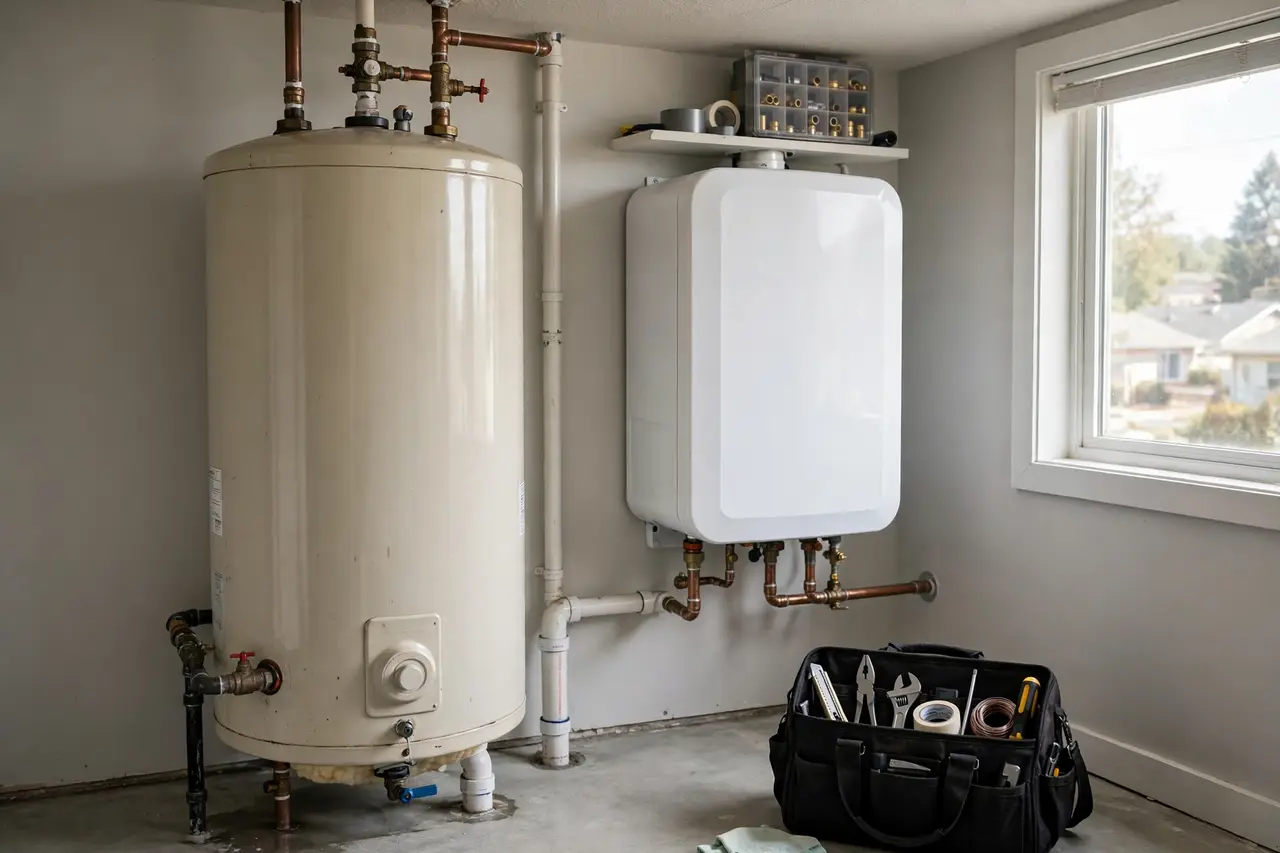
If you own a tank water heater, or you are thinking about what a tankless unit would mean for future repairs, one question usually comes first: which type is simpler — and less costly — to keep running? The honest answer is that neither type is simply "cheap" or "expensive" to repair. Tank and tankless units fail in different ways, use different parts, and place different demands on the technician who fixes them. This guide compares those differences in plain terms, so you can judge what a repair is likely to involve for your own home in Lynnwood.
How tank and tankless designs differ — and why that shapes repairs
A tank water heater stores a full tank of hot water and keeps it hot around the clock. Its main parts are familiar and relatively few: a burner or heating elements, a thermostat, a tank with an anode rod inside, a temperature-and-pressure (T&P) relief valve, and the pipes and fittings that carry water in and out. When something goes wrong, the fault is usually in one of those parts, and the parts themselves are widely made in standard sizes.
A tankless unit has no stored water. It heats water on demand as it flows through a compact heat exchanger, using a burner or electric elements controlled by sensors, a flow sensor, and a small computer board that watches temperature, flow, and safety limits. That design removes the tank itself — and with it, the whole category of tank leaks and tank corrosion — but it adds electronics, sensors, and narrow water passages that a tank unit simply does not have. So a tankless repair is less often about a single chunky part and more often about diagnosis: working out which sensor, valve, or passage is behind the symptom.
That design difference drives almost everything that follows. Tank repairs tend to be physically straightforward but sometimes messy, because you are dealing with stored water and sediment. Tankless repairs tend to be cleaner but more diagnostic, because the unit itself will often tell you something is wrong — through an error code or a change in behaviour — without making it obvious which component is at fault.
What typically goes wrong with tank units
The most common tank complaint in Lynnwood homes is sediment. Minerals in the water settle on the tank floor, where they form a crust that makes heating less efficient and can cause popping or rumbling noises. Left alone, sediment overheats the tank floor and shortens the life of the unit. Flushing the tank and clearing sediment is routine work, but on a badly scaled tank it can take longer, and a drain valve clogged with sediment sometimes needs attention of its own.
Next come the heating parts. On an electric tank unit, an element can burn out or short, and a thermostat can stick or fail, leaving you with lukewarm water, water that runs out too fast, or no hot water at all. On a gas tank unit, the equivalent faults are a pilot that will not stay lit, a faulty thermocouple, or a gas valve problem. These are among the most straightforward repairs in water heating: the parts are standard, the diagnosis is usually quick, and the work is well understood. Our guides on heating element repair and thermostat repair explain the symptoms in more detail.
Then there is the anode rod, the sacrificial rod inside the tank that corrodes so the tank itself does not. When it is spent, rusty or smelly hot water often follows, and the tank starts ageing faster. Replacing an anode rod is a preventive repair in the best sense: a modest job that protects a much larger one. It is worth noting, though, that on older tanks a seized anode rod can be difficult to remove, and a technician may need extra time and care to avoid damaging fittings.
Finally, tank units leak — from fittings, from the T&P valve, or, in the worst case, from the tank body itself. A leaking fitting or valve is usually repairable. A tank body that has corroded through is not a repair in any practical sense: once the steel of the tank itself has failed, the sensible conversation turns to what comes next for the household, not to patching the tank. That distinction matters when you weigh repair against the age of the unit, and we cover it honestly in our repair vs replace guide.
What typically goes wrong with tankless units
Tankless faults cluster around flow and scale. Because water is heated as it passes through narrow passages in the heat exchanger, mineral scale builds up faster in relative terms than in a tank, especially in harder water. Scale narrows the passages, restricts flow, and forces the unit to work harder; the usual symptoms are fluctuating temperatures, reduced hot water flow, whistling, or error codes. Descaling a tankless unit is a standard service, but it takes longer than a tank flush because the heat exchanger must be circulated and cleaned thoroughly, and the unit must then be tested across its full temperature range.
The second cluster is sensors and controls. A flow sensor that misreads, an inlet filter clogged with debris, a flame sensor that needs cleaning, or an ignition fault can all stop the unit from firing or cause it to shut down mid-shower. The unit will usually display an error code, which narrows the search — our tankless error codes guide explains what those codes generally point to — but confirming the faulty component still takes methodical testing, and the parts are often specific to the brand and model rather than interchangeable.
The third cluster is venting and condensate on gas tankless units, and electrical supply on electric ones. A blocked or poorly routed vent, a condensate drain problem, or an electrical fault can each shut the unit down as a safety measure. These faults are less frequent than scale and sensor problems, but they can take longer to trace because the cause may sit outside the unit itself, in the vent run or the supply circuit.
What tankless units rarely do is leak from a corroding tank, because there is no tank. A tankless leak is more likely to come from a fitting, a valve, or a heat exchanger joint — usually a smaller, more contained problem than a failed tank, though a heat exchanger fault is one of the more involved tankless repairs.
Parts: availability and specificity
This is where the cost comparison most often tips. Tank parts — elements, thermostats, thermocouples, gas valves, T&P valves, anode rods — are made to common standards and are widely stocked. A technician can often complete a tank repair in a single visit because the needed part is on the van or readily available locally. That keeps both the labour time and the wait for hot water down.
Tankless parts are a different story. Control boards, sensors, and heat exchanger components are frequently brand- and model-specific, and less commonly carried as general stock. That does not mean they are hard to obtain, but it can mean a second visit once the correct part arrives, and a longer period without full hot water in the meantime. It also means the technician needs to identify the exact model and part number before ordering — another reason accurate diagnosis matters so much on tankless work.
Age sharpens this difference for both types. Parts for a current or recent model are usually easy to find. Parts for a much older unit, tank or tankless, can become scarce, and at that point the availability question starts to matter as much as the fault itself. If a part is no longer made, a repair that looks simple on paper may not be practical at all, and that is something a technician should tell you plainly rather than promising a fix that cannot be completed.
Labour and repair complexity: time on site
For a like-for-like common fault — say, a failed thermostat or element on a tank unit versus a clogged inlet filter or a flame sensor on a tankless unit — the tank repair is typically the simpler job. The parts are accessible, the testing is direct, and the unit can usually be drained, repaired, and refilled in a predictable sequence. Tankless work, by contrast, often begins with a longer diagnostic phase: reading error codes, checking flow rates and gas pressure or electrical readings, and testing sensors one by one before any part is changed.
That said, complexity is not one-directional. Some tank jobs are heavy and slow: draining and flushing a badly scaled tank, freeing a seized anode rod, or tracing a leak that only appears when the tank is fully hot. And some tankless jobs are quick: cleaning an inlet filter or resetting a unit after a power interruption can be resolved in a single short visit. The fair generalisation is that tank repairs are more often limited by physical access and water handling, while tankless repairs are more often limited by diagnosis and part specificity.
Access matters for both. A tank unit in an open garage is far easier to work on than one squeezed into a tight closet, and a wall-mounted tankless unit at an awkward height or behind stored items slows any job down. Clearing the area around the unit before a visit is one of the simplest ways to keep a repair straightforward, whichever type you own.
How diagnosis differs between the two
Tank diagnosis is mostly physical: listen for sediment noise, check temperatures at taps, test elements and thermostats, inspect for leaks, and look at the condition of the anode rod and valves. The symptoms usually point fairly directly at the fault, and a technician can often confirm the diagnosis with a small number of tests.
Tankless diagnosis is more instrumented. The unit's display, error codes, and sensor readings give the technician a starting point, but those readings still need interpretation — an error code can indicate a symptom rather than the root cause, and two different faults can produce the same code. A careful technician will verify the code against actual flow, temperature, and supply readings before changing parts, because replacing a sensor that was only reporting a problem elsewhere wastes both time and money. Homeowners can help by noting exactly when the fault happens — only at high flow, only in the morning, only when another tap opens — because those patterns are genuinely useful diagnostic clues.
The long-run repair picture
Over the life of a unit, the repair profiles diverge further. A tank unit's long-run story is dominated by sediment and corrosion: regular flushing and timely anode rod attention keep it in good shape, but the tank itself has a finite life, and once corrosion reaches the tank body, repair stops being an option. In that sense, tank ownership is a story of steady, mostly modest repairs that eventually reach a natural end point.
A tankless unit's long-run story is dominated by scale and electronics. With regular descaling — especially important where water is hard — and clean filters, a tankless unit can run for a long service life without a tank to corrode. But its repair needs, when they come, are more likely to involve a specific electronic or sensor part, and the cost of that part can be higher than a standard tank component, even though the job itself may be no longer. In other words, tankless ownership tends to mean fewer routine interventions but more specialised ones.
Neither pattern is inherently better; it depends on what you value. If you prefer repairs that are quick, standard, and easy to predict, a tank unit's profile suits that preference. If you prefer to avoid tank-related failures altogether and you are comfortable with occasional specialised attention, a tankless unit's profile may suit you better. What matters most in both cases is catching problems early: a scale problem found early is a service visit, while the same problem left for months can become a component failure.
Repair or replace? An honest framework
Every repair comparison eventually raises this question, and it deserves a straight answer. Repair usually makes sense when the fault is a single component, the rest of the unit is sound, and parts are available. It makes less sense when the tank body itself has failed, when faults keep recurring in different parts, or when the part you need is no longer made. Age alone is not the deciding factor — a well-kept older unit with one failed thermostat is a very different case from a unit of the same age with corrosion, repeated leaks, and a history of faults.
We do not sell replacement as a service, and this guide is not a pitch for a new unit. The point of the framework is simpler: a good repair decision weighs the fault, the condition of the rest of the unit, parts availability, and how much disruption another breakdown would cause your household. A technician who explains those four factors plainly, and who is willing to say "this one is worth repairing" or "this one is not", is giving you the information you actually need. If you are facing that decision, our repair vs replace guide walks through the same questions in more depth.
What to tell your technician
Whichever type you own, a few details make diagnosis faster. Note when the problem started, whether it is constant or intermittent, what the water temperature and flow do when it happens, and whether the unit shows an error code or makes an unusual noise. For a tank unit, mention any leaks, however small, and any rumbling or popping. For a tankless unit, mention temperature swings and whether the fault happens at every tap or only one.
Also mention the unit's approximate age if you know it, and whether it has had previous repairs. That history helps a technician judge whether a new fault is isolated or part of a pattern. The Heater Medics serves homes across Lynnwood — including Alderwood Manor, Meadowdale, Martha Lake, and North Lynnwood — with same-day appointments for urgent faults. Call (866) 572-3596 during our hours, Monday to Friday 7AM to 7PM and Saturday 8AM to 4PM, with 24/7 emergency availability, and describe what your unit is doing; we will tell you what the repair is likely to involve before any work begins.
Frequently Asked Questions
Is a tank water heater cheaper to repair than a tankless unit? For common faults, generally yes. Tank parts are standard, widely stocked, and the diagnosis is usually direct, so the visit is often shorter. Tankless repairs can involve brand-specific parts and longer diagnostic work, which can make the overall job more involved even when the faulty part itself is small.
Why do tankless repairs sometimes take longer? Two reasons dominate: diagnosis and parts. A tankless unit's error code points to a symptom that still needs verifying against flow, temperature, and supply readings, and the replacement part is often specific to the brand and model rather than a standard item carried as general stock.
What repair comes up most often on tank units? Sediment-related problems lead the list, followed by failed elements or thermostats on electric units, pilot and gas valve faults on gas units, and anode rod or T&P valve attention. Leaks from fittings are also common; a leak from the tank body itself is a different, more serious matter.
Do tankless units break down more often than tank units? Not necessarily — they break down differently. Tank units face sediment and corrosion over time, while tankless units face scale in the heat exchanger and sensor or control faults. Regular descaling and filter cleaning prevent many tankless faults, just as flushing and anode rod attention prevent many tank faults.
Does the age of the unit change the repair comparison? Yes, for both types. On an older tank unit, corrosion may mean the tank body itself is failing, at which point repair is no longer practical. On an older tankless unit, sensors and control parts may become scarce. Parts availability is often the deciding factor on an older unit of either type.
Should I switch types just to save on future repairs? Repair costs alone are a weak reason to switch. Household hot water demand, gas or electric supply, water hardness, and available space matter at least as much. If your current unit is otherwise sound, repairing it is usually the sensible step; a technician can assess its overall condition first.