
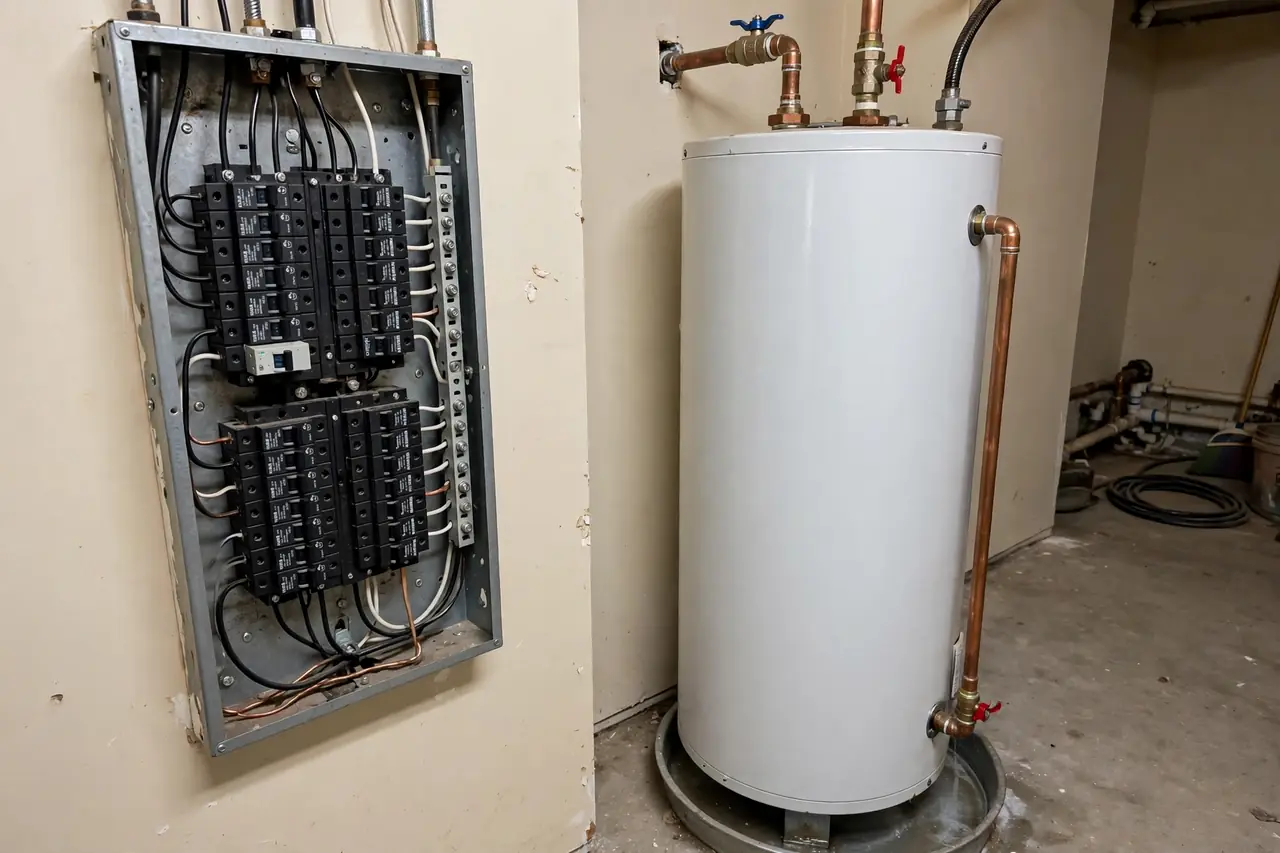
Hot water one minute, a tripped breaker the next — and then it happens again. A breaker that keeps tripping on your water heater circuit is not a nuisance to work around; it is a safety device doing its job, telling you that something on that circuit is drawing too much current or leaking current where it should not go. This guide explains the electrical causes, how to tell a heater fault from a panel fault using only safe observations, and the steps to take without ever working on live wiring.
Safety first: Never remove an electrical panel cover, open a water heater access cover to probe wiring, or touch wiring, terminals, or breakers with wet hands or while standing in water. The only electrical step a homeowner should take is switching a breaker fully off at the panel — and only if the panel is dry and safe to reach. Everything else belongs to a qualified technician or electrician.
What a tripping breaker is telling you
A circuit breaker trips when the current on its circuit exceeds what it can safely carry, or when it detects a fault such as a short circuit or a ground fault. Think of it as a guard, not a switch: it cuts power to protect the wiring, the appliance, and your home from overheating and fire. A breaker that trips once after a power surge and then holds may have done nothing more than its job. A breaker that trips repeatedly — especially every time the water heater heats — is pointing at a real fault that will not fix itself, and repeatedly resetting it only stresses the wiring further.
Water heaters draw a heavy electrical load, particularly electric models, which is why their faults show up at the breaker so clearly. Gas water heaters use far less electricity — mainly for controls and ignition — so a repeatedly tripping breaker on a gas unit points more strongly toward the supply circuit or the controls than toward a heating element. That distinction is a useful first clue, and it is one reason a technician will always ask whether your unit is gas or electric before anything else.
A shorted heating element
On an electric water heater, the most common cause of a tripping breaker is a heating element that has shorted. Elements sit immersed in water inside the tank. Over time, scale, corrosion, or simple wear can crack the element's outer sheath, letting water reach the internal conductor. The result is a short circuit or a ground fault: current escapes along an unintended path, and the breaker trips — often partway through a heating cycle, once the element has warmed up and the fault path opens.
The pattern is often distinctive. The breaker may hold for a while after being reset, then trip again as the water heats, or it may trip as soon as the heater calls for heat. You may also notice lukewarm water or hot water that runs out unusually fast, because only one of the two elements is still working. A shorted element is a heater repair, not a panel repair, and it is one of the more routine jobs on an electric unit — provided it is diagnosed properly rather than guessed at. Our heating element repair guide describes the symptoms in more depth, and our electric water heater repair page covers the wider range of electric faults.
One important caution: a shorted element means water and electricity have already met inside the tank. Do not keep resetting the breaker to "get through one more shower". Leave the breaker off and arrange a repair visit. Continued resetting risks further damage to the wiring and, in the worst case, to the tank's electrical components.
A faulty thermostat
Thermostats control when each element heats, and a thermostat that sticks in the "on" position can cause an element to overheat. Overheating can, in turn, trip the high-limit safety cut-out — and, if the element itself is damaged by the excess heat, trip the breaker as well. A thermostat fault can also cause both elements to run at once on a unit designed to run them one at a time, overloading the circuit.
The symptoms overlap with element faults: water that is scalding hot, water that is lukewarm, or a breaker that trips after the heater has been running for a while. Telling a thermostat fault from an element fault takes testing with the power off — measuring resistance and continuity — which is technician work, not homeowner work. The two parts are often replaced together when one has damaged the other, and a good technician will explain which part failed first so the same fault does not recur. See our thermostat repair guide for the warning signs.
Damaged wiring, loose connections, and moisture
Wiring faults are the second major family of causes, and they deserve respect because they can be harder to see. Wires feeding the heater can be damaged by heat, vibration, rodents, or simply age; insulation can crack where wires enter the unit; and connections can loosen over years of heating and cooling cycles. A loose connection creates resistance, resistance creates heat, and heat damages insulation — a slow chain that eventually ends in a short or a ground fault that trips the breaker.
Moisture makes everything worse. A small leak from a fitting, a T&P valve, or the tank itself can drip onto wiring or into the heater's electrical compartment. Water on live parts is an immediate hazard, and it is also a common reason a breaker starts tripping after years of quiet service: the leak is new, even though the heater is not. If you can see water pooling near the heater, keep away from the unit, do not touch anything electrical, and switch the breaker off at the panel only if you can do so without stepping in water or touching wet surfaces. Then call for a repair visit and mention the water when you call — it changes the urgency.
Other wiring causes sit further from the heater: a damaged cable run between the panel and the unit, or a junction box fault. These are less common, but they are exactly the kind of fault where the heater itself is innocent and the circuit is not. That is why a proper diagnosis checks the whole circuit, not just the unit.
When the breaker itself is the problem
Sometimes the breaker is the fault. Breakers wear out: the internal mechanism weakens with age and with repeated tripping, so an old breaker can start tripping at loads it once carried without trouble. A breaker that feels loose in the panel, that trips with a light touch, or that will not stay reset even when the heater is switched off at the unit may itself be failing.
Another possibility is a circuit that was never right for the load — for example, a water heater sharing a circuit with other heavy appliances, or a breaker rated below what the heater requires. This sometimes comes to light after a change in the home: a new appliance on the same circuit, or a heater replaced long ago with a model that draws more current. In both cases the fix belongs to an electrician, who can assess the panel, the circuit rating, and the wiring — not to repeated breaker resets, and not to swapping in a larger breaker, which must never be done without checking that the wiring can safely carry the higher rating.
A related clue is heat at the panel itself. A breaker that is warm to the touch, or a faint burning smell near the panel, should be treated as urgent: switch the circuit off if it is safe to do so, and call an electrician promptly. Do not remove the panel cover to look inside.
Heater fault or panel fault? How to tell from safe observations
You do not need to open anything to gather useful clues. These observations — all made without touching wiring — help a technician or electrician arrive at the right diagnosis faster:
- Timing: Does the breaker trip only when the water heater is heating, or at random times? Trips tied to heating cycles point to the heater; random trips point more toward the circuit or the breaker.
- Reset behaviour: Does the breaker hold for a while and then trip again as water heats, or does it trip immediately on reset? Immediate tripping suggests a hard short; delayed tripping suggests a fault that develops as parts warm up, such as a shorted element or a sticking thermostat.
- Other circuits: Are other circuits affected, or is it only the water heater circuit? Other circuits tripping, flickering lights, or outlets losing power point to a wider panel or supply problem — electrician territory.
- Water and smell: Is there water near the heater, a burning smell, or scorch marks around the heater's access covers? Any of these raises the urgency and should be mentioned when you call.
- Recent changes: Has anything changed recently — a new appliance, recent electrical work, a leak, or a period of heavy hot water use? Changes often explain a fault that seems to have appeared from nowhere.
None of these observations replaces testing, and none of them requires you to open a cover or handle wiring. Their value is in narrowing the search before a professional arrives, so the right person with the right parts comes first.
Safe steps to take now
If your water heater keeps tripping the breaker, follow these steps in order. Every one of them is safe for a homeowner, and none of them involves live electrical work:
- Switch the water heater circuit fully off at the panel — push the breaker firmly to the off position — if the panel is dry and safe to reach. Do not stand in water to do this.
- Do not keep resetting the breaker. A breaker that trips again after one reset is telling you the fault is still there. Repeated resets heat the wiring and can turn a repairable fault into a dangerous one.
- Note the pattern: when it trips, whether water is near the unit, whether there is a smell, and whether other circuits are affected. Write it down; it helps the technician.
- Keep the area around the heater dry and clear, and keep everyone, including children and pets, away from any pooled water near electrical equipment.
- Call for help and describe what you observed. Mention the pattern, any water, and any smell. That description decides whether you need a heater technician, an electrician, or an urgent visit.
If you smell burning, see smoke, or cannot reach the panel safely, leave the area and call your electricity provider or emergency services as appropriate, then arrange professional help. If there is a gas smell at a gas unit, leave the house and call your gas utility first — do not switch anything electrical on or off on your way out.
When to call a repair technician vs an electrician
The dividing line is straightforward. Call a water heater repair technician first when the symptoms point to the heater: trips tied to heating cycles, lukewarm or scalding water, a known element or thermostat history, or an error pattern that matches a heater fault. A heater technician will test the elements, thermostats, and safety cut-out with the power off, and repair or replace the faulty heater component. For urgent cases, our emergency repair team is available around the clock.
Call an electrician first when the symptoms point to the circuit or panel: other circuits affected, a breaker that will not stay reset even with the heater isolated, heat or a burning smell at the panel, flickering lights, or a circuit that appears shared or undersized for the heater. An electrician will assess the breaker, the circuit rating, and the wiring, and will correct panel or circuit faults that a heater technician should not touch.
In practice, the two trades overlap, and a good technician will say so: if a heater technician finds the heater sound but the circuit faulty, they will refer you to an electrician rather than guessing further, and an electrician who finds a shorted element will say the heater needs repair. Do not be put off by a referral — it means the diagnosis was honest. What matters is that the fault is found by the person qualified to fix it, not that the first person called happens to fix everything.
What a visit will check
With the power safely off, a technician or electrician will work through the circuit methodically: the breaker itself, the wiring and connections to the heater, the elements and thermostats, the high-limit safety cut-out, and any sign of water reaching electrical parts. They will test rather than assume, because several faults produce the same tripped breaker, and replacing the wrong part leaves the real fault in place.
Most tripping-breaker visits end with a single clear cause — a shorted element, a failed thermostat, a damaged wire, or a worn breaker — and a repair that addresses that cause directly. If the visit finds a leak that caused the electrical fault, both problems need attention: drying and repairing the leak as well as the electrical damage, or the fault will return. The Heater Medics serves homes across Lynnwood, including Alderwood Manor, Meadowdale, Martha Lake, and North Lynnwood. Call (866) 572-3596, Monday to Friday 7AM to 7PM and Saturday 8AM to 4PM, with 24/7 emergency availability, and describe the tripping pattern; we will advise whether a heater technician or an electrician is the right first call.
Frequently Asked Questions
Can I just reset the breaker and keep using the water heater? No — not repeatedly. A breaker that trips again after being reset is signalling a fault that is still present. Leave the circuit off and arrange a professional visit. Repeated resets heat the wiring and can turn a repairable fault into a dangerous one.
Is a tripping breaker dangerous? It can be. Tripping often means a short circuit, a ground fault, or an overloaded circuit, and any of those can damage wiring or start a fire if ignored. Treat repeated tripping seriously, keep the circuit off, and get it diagnosed rather than working around it.
How do I know if it is the breaker or the heater? Use safe observations only: trips tied to heating cycles point to the heater, while random trips, other circuits affected, or a breaker that will not stay reset even with the heater isolated point to the circuit or breaker. A technician or electrician confirms the cause by testing with the power off.
Should I call a water heater technician or an electrician? Call a heater technician when symptoms point to the heater — trips during heating, temperature problems, or a known element or thermostat history. Call an electrician when symptoms point to the panel or circuit — other circuits affected, heat or burning smell at the panel, or a shared or undersized circuit. Either professional will refer you onward if the fault lies in the other's area.
Can I check anything myself safely? Yes, without opening anything: note when the breaker trips, whether water is near the heater, whether there is a burning smell, and whether other circuits are affected. Switch the circuit off at the panel only if the panel is dry and safe to reach. Never remove a panel cover or a heater access cover, and never touch wiring or terminals.
What if there is water near the heater and the breaker keeps tripping? Keep away from the unit and any pooled water, and do not touch anything electrical. Switch the circuit off at the panel only if you can do so without stepping in water. Then call for a repair visit promptly and mention the water — a leak reaching electrical parts makes the job urgent.