
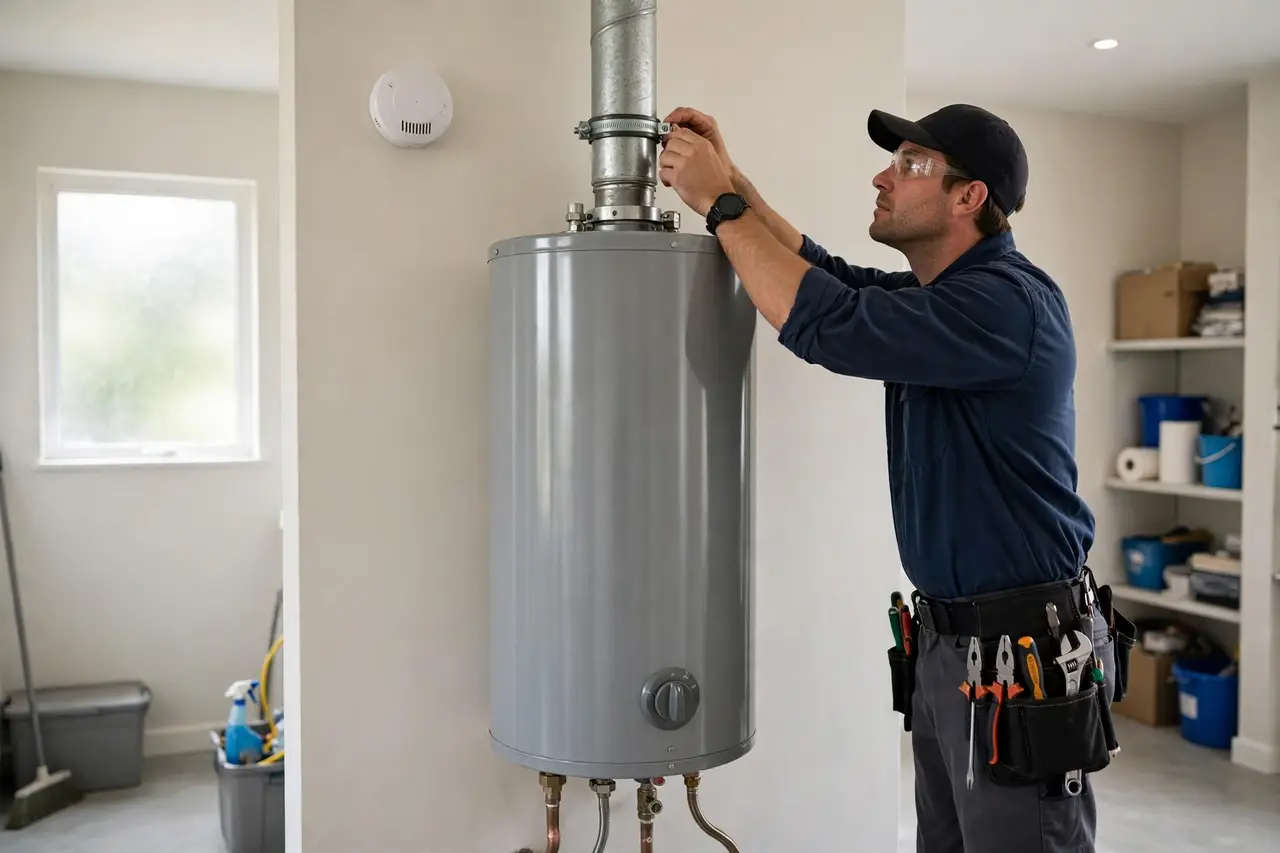
Carbon monoxide is one of the few water heater hazards you cannot see, smell, or taste — and that is exactly what makes it so dangerous. A gas water heater burns fuel to heat your water, and under normal conditions the combustion gases it produces are carried safely outside through a vent. When something goes wrong with combustion or venting, that invisible gas can build up indoors instead. This guide explains how that risk arises, the warning signs to watch for, where to place detectors, and — most importantly — what to do if an alarm ever sounds. If you take one thing from this article, let it be this: if a carbon monoxide alarm sounds, leave your home immediately and call 911 or your gas utility from outside.
What is carbon monoxide — and why it matters
Carbon monoxide (CO) is a colorless, odorless gas produced when fuel burns incompletely. Fuel-burning appliances are designed to vent their exhaust outside. Problems begin only when combustion goes wrong or the exhaust cannot escape as designed. Because CO has no smell and no color, you cannot rely on your senses to detect it — only a working carbon monoxide detector can warn you in time.
Breathing carbon monoxide is dangerous because it interferes with how blood carries oxygen around the body. Early symptoms often feel like a common illness: headache, dizziness, nausea, fatigue, or confusion. At higher concentrations, carbon monoxide can cause loss of consciousness and can be fatal. This is why safety guidance treats any CO alarm as an emergency, not as a nuisance to silence and check later. If several people or pets in the home feel ill at the same time, or symptoms improve when you leave the house and return when you come back, treat that pattern as a serious warning sign and get out and call for help.
How carbon monoxide risk arises from a gas water heater
A healthy gas water heater burns natural gas cleanly and sends nearly all of its exhaust up the flue and out of the house. Carbon monoxide risk appears when either side of that process breaks down: the burner does not burn cleanly, or the exhaust does not leave the house properly. Understanding both sides helps you recognize trouble early.
Incomplete combustion. A gas burner needs the right mix of gas and air to burn cleanly. When the burner is dirty, corroded, or misadjusted, or when the air supply around the unit is restricted, the flame burns inefficiently and produces more carbon monoxide. A healthy gas flame is mostly steady and blue with small, well-defined cones. A lazy, yellow, flickering flame, or a flame that lifts away from the burner, can indicate a combustion problem. Soot or black marks around the burner area, on the outside of the tank, or near the vent connection are another sign that combustion is not clean. If you notice these signs, do not try to clean or adjust the burner yourself — gas burner work belongs to a qualified technician.
Blocked or damaged venting. The vent pipe (flue) carries exhaust from the top of the water heater to the outside. If that pipe is disconnected, corroded, crushed, or blocked — by debris, a bird's nest, snow, or ice in winter — exhaust can spill back into the room instead of leaving the house. Vent pipes can also come apart at joints over time, especially in garages and utility rooms where they get bumped. A vent that slopes the wrong way or is shared with another appliance can cause the same problem. Any visible damage, sagging, rust, or separation in the vent pipe is a reason to stop using the unit and call a technician.
Backdrafting and negative air pressure. Even a sound vent can fail to draw properly. A chimney or flue works by rising warm air pulling exhaust upward, but strong exhaust fans — a kitchen range hood, a bathroom fan, a clothes dryer, or a furnace running at the same time — can pull air out of the house faster than it comes back in, creating negative pressure that drags exhaust down the flue and into the room. Backdrafting is more likely in tightly sealed homes and in winter, when windows stay shut and heating appliances run hardest. If you notice exhaust smells, excess moisture, or a pilot light that keeps going out, backdrafting is one possible cause worth having checked. Our guide on a pilot light that keeps going out explains more about pilot problems.
Cracked heat exchanger or damaged components. Inside a gas water heater, the burner heats water through metal surfaces. If those surfaces crack or corrode — often after years of heat cycling — combustion gases can escape into the surrounding air rather than going up the flue. This damage is not visible from outside the unit, which is why a technician's inspection matters. Worn parts such as a failing thermocouple or gas valve can also cause erratic burner behavior, including a pilot that will not stay lit.
Warning signs you should never ignore
Because carbon monoxide itself is undetectable by human senses, the warning signs are indirect — changes in the appliance, changes in the room, or changes in how people feel. Watch for any of these:
- Physical symptoms in the household: headaches, dizziness, nausea, fatigue, or confusion that affect more than one person, or that ease outdoors and return indoors.
- Soot or staining: black or brown marks around the water heater, on the vent pipe, or on nearby walls and ceilings.
- Flame changes: a burner flame that is mostly yellow, lazy, or flickering rather than steady and blue, or a pilot light that frequently goes out.
- Moisture and condensation: unusual condensation on windows or walls near the water heater, or a damp, musty smell in the utility area.
- Exhaust smells: any smell of exhaust or gas near the unit. Note that natural gas itself is given a rotten-egg smell on purpose so leaks can be noticed — a gas smell is a separate emergency in its own right: leave and call your gas utility.
- Detector warnings: any carbon monoxide alarm, even a brief one. Never assume an alarm is faulty until a professional or emergency responder has checked. A low-battery chirp is different from an alarm — learn the difference for your model, and treat a full alarm as real.
Any one of these signs deserves prompt attention; a combination of them should be treated as urgent: leave the home and call for help, then have a technician inspect the unit before it is used again.
Carbon monoxide detectors: where to put them
A carbon monoxide detector is the only reliable early warning you have, and where you put it matters as much as owning one. Safety guidance from fire services and detector manufacturers is consistent on the essentials, and it is worth following closely.
Put a detector on every level of your home, including the basement if you have one, and outside each sleeping area so an alarm can wake you at night. If your water heater sits in a garage or utility room, place a detector in the living space adjacent to that area as well. Do not mount a detector directly above or right next to a fuel-burning appliance — steam, dust, and normal startup exhaust can cause nuisance alarms — but do keep one within a reasonable distance of the room where the appliance lives, ideally in a hallway or adjoining room. Follow your model's instructions for height and mounting.
Choose the right type and keep it working. Battery-powered detectors, plug-in models with battery backup, and hardwired models with battery backup are all widely available. Battery backup matters because a power outage in a Lynnwood winter storm is exactly when gas appliances are working hardest. Test each detector monthly by pressing its test button, replace batteries when it chirps for low battery, and replace the whole unit when it reaches the end of its life — most detectors last around seven to ten years, and the manufacture date is printed on the back. If a detector is past its expiry date, it may not respond at all, so check the date when you move into a home or take over a rental. Keep detectors clean and free of dust, and never paint over them or cover them with decorations.
One detector is better than none, but a single detector in a far bedroom will not protect a household quickly if the water heater is in the garage at the other end of the house. For Lynnwood homes with a gas water heater, a gas furnace, and a gas stove, detectors on every level and outside sleeping areas are a sensible minimum.
What to do if a carbon monoxide alarm sounds
Remember these steps, because they matter most when you are frightened and half awake. If your carbon monoxide alarm sounds, or you suspect a carbon monoxide leak for any reason:
- Leave the home immediately. Get every person and pet out, and do not stop to open windows, hunt for the source, or silence the alarm first. If someone is feeling ill, help them out too, but do not delay leaving to search the house.
- Call 911 or your gas utility from outside. Call from a neighbor's phone or your mobile once you are out, or from a neighbor's home. Tell them the CO alarm sounded and whether anyone feels ill.
- Do not go back inside until emergency responders or the gas utility say it is safe. Do not restart the water heater or any other fuel-burning appliance until the source has been found and fixed.
- Seek medical attention if anyone has symptoms such as headache, dizziness, nausea, or confusion, even if they feel better outdoors. Tell medical staff that carbon monoxide exposure is suspected.
- Have the appliance inspected before it is used again. A technician needs to find and fix the cause — a blocked vent, a combustion problem, or a failed component — before the unit goes back into service. If the alarm sounded and no source is found, have the detector itself checked, but never assume the alarm was false on your own.
What not to do matters just as much. Do not try to ventilate the house and stay inside, do not relight a pilot light or reset a gas appliance after an alarm, and do not attempt to repair, adjust, or disconnect gas lines or venting yourself. Gas and venting work carries a risk of fire, explosion, and further carbon monoxide exposure, and mistakes are often invisible until someone is harmed.
How a technician fixes venting and combustion problems
When you call The Heater Medics about a suspected venting or combustion problem, the visit starts with safety checks, not guesswork. A technician inspects the vent pipe along its full run for disconnection, corrosion, sagging, or blockage, checks the draft — whether exhaust is actually rising up the flue — and looks for soot or staining that points to spillage. They examine the burner and flame pattern, test the pilot and gas controls, and check that the unit has adequate combustion air. They test the air around the unit after repair to confirm the problem is resolved.
Common repairs include refitting or replacing a damaged section of vent pipe, clearing a blocked flue, cleaning or adjusting a burner that is burning dirty, and repairing or replacing a faulty gas control component such as a thermocouple or gas valve. In homes where backdrafting is the cause, the fix may involve improving combustion air supply or adjusting how the vent is configured — work that requires testing, not trial and error. A technician will also tell you honestly if damage, such as a cracked internal component, makes continued repair unwise, and explain your options clearly. See our gas water heater repair page for what a repair visit covers.
The important boundary is this: anything involving gas supply, burner adjustment, or venting is professional work. Homeowners can — and should — keep the area around the water heater clear, keep detectors working, and watch for warning signs. Everything beyond that, from opening a gas valve to altering a flue, should wait for a technician. If a problem is found during a routine visit, it is fixed and tested before the technician leaves, so you are not left wondering whether the unit is safe.
Simple habits that lower the risk
Most carbon monoxide incidents are preventable with a few steady habits. Keep the area around your water heater clear of boxes, paint cans, solvents, and laundry — stored items can block combustion air or get knocked into the vent pipe. Never block vents, air intakes, or the space under a utility room door, and never use a gas water heater area for storage that crowds the unit. In winter, check that outside vent terminals are not buried by snow or blocked by ice, and keep an eye out for debris or nests in warmer months.
Pay attention to the flame when you happen to see the unit — a steady blue flame is normal, and a yellow, lazy flame or a pilot that keeps dropping out is worth a call. The same goes for any new soot marks, rust on the vent, or condensation that was not there before. If you ever smell gas, treat it as its own emergency: leave the home and call your gas utility, and do not operate light switches or phones inside the house. And keep your detectors on a routine — test monthly, change batteries promptly, and note the expiry date somewhere you will see it.
Carbon monoxide safety is not complicated, but it does depend on two things working together: a detector that can warn you, and a water heater whose combustion and venting are in good order. If anything in this guide sounds familiar — a yellow flame, soot marks, a pilot that will not stay lit, or an untested detector — do not put it off. The Heater Medics serves Lynnwood neighborhoods including Alderwood Manor, Meadowdale, Martha Lake, and North Lynnwood, with 24/7 emergency response. Call (866) 572-3596 — our team is at 2250 186th St SW #109, Lynnwood, WA 98037, open Mon–Fri 7AM–7PM and Sat 8AM–4PM, with 24/7 emergency service. And remember: if an alarm ever sounds, leave immediately and call 911 or your gas utility first.