
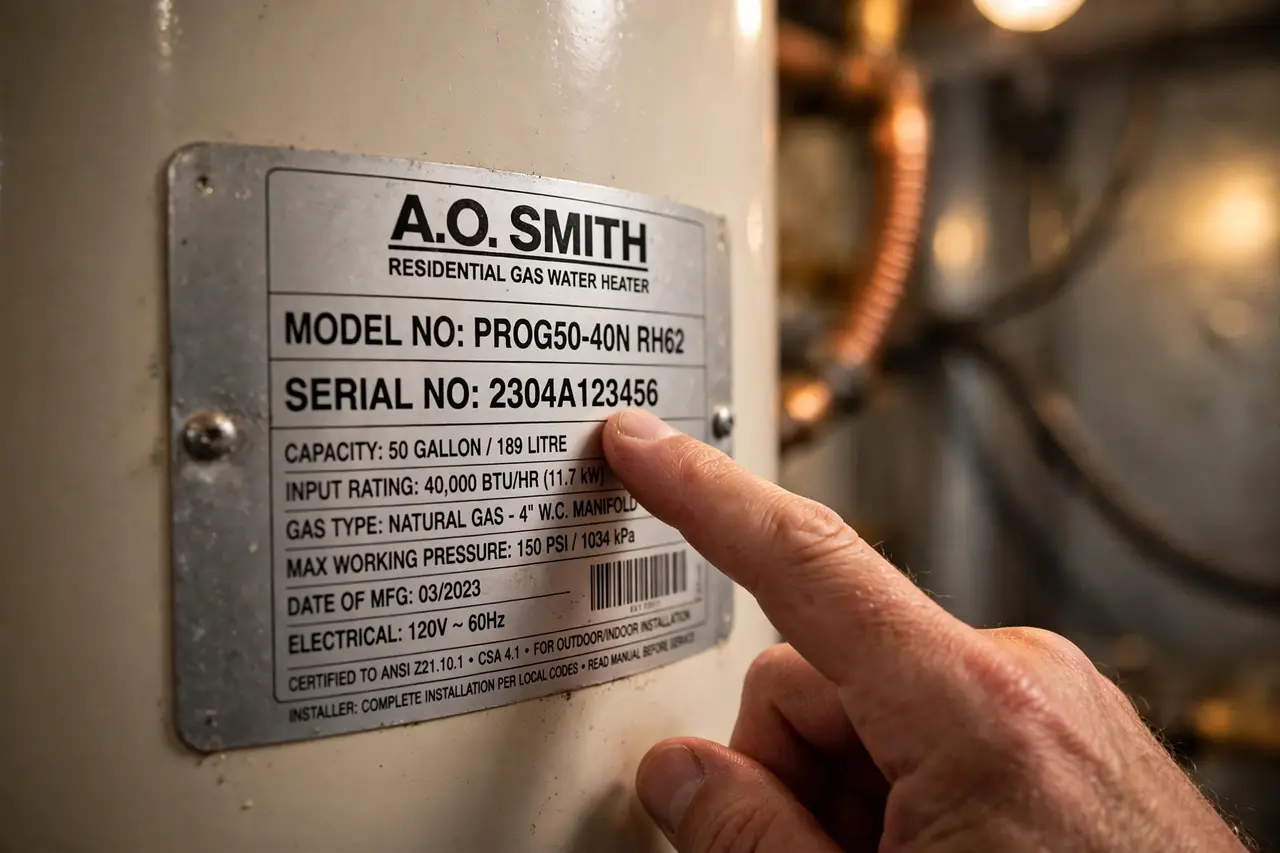
When a water heater starts acting up, the first question a technician asks is usually how old it is. Age shapes everything that follows: which parts are still available, whether corrosion is likely, and whether a repair is a smart investment or money spent on a unit near the end of its service life. The good news is that you do not need the original paperwork to answer that question. The manufacture date is encoded in the serial number printed on the unit's rating plate, and with a few minutes and a flashlight you can usually decode it yourself. This guide shows Lynnwood homeowners where to find that plate, how the major brands encode their dates, and what the answer means for your next repair decision.
Where to find the rating plate
The rating plate is a sticker or metal tag fixed to the water heater itself, and it carries the model number, serial number, fuel type, tank capacity, and energy ratings. On a standard tank unit, look on the side of the tank, usually near the top or just above the gas valve or lower access panel. On electric models it is often beside or just above the upper element access panel. On a tankless unit, check the side of the cabinet or the underside, where the label faces outward for service access.
Bring your phone and a flashlight. Utility rooms, garages, and closets in Lynnwood homes are often dim, and the print on older plates is small. Take a clear photo of the whole label rather than trying to copy the serial number by hand — one wrong digit can change the decoded year. If the unit is tucked behind stored items, move them enough to see the label without leaning across hot pipes or the vent. Do not remove covers, panels, or gas controls to reach a label. If you smell gas at any point, do not touch electrical switches or try to investigate the unit: leave the home and call your gas utility or emergency services from outside, then call a repair professional once the utility has cleared the home.
How to read the serial number
Start by looking for a plainly printed manufacture date. Some labels state it outright, in a field marked "MFG date," "Date of manufacture," or similar — if yours does, you are done. Most labels, though, give only a model and serial number, and the date hides inside the serial. The catch is that every manufacturer uses its own code, and most have changed their format at least once over the decades. The patterns below cover the brands most common in Lynnwood homes, but treat them as a starting point and confirm against the manufacturer's own decoder when a result looks surprising.
- Rheem and Ruud: On many Rheem and Ruud units, the first four digits of the serial number encode the month and year — the first two digits are the month and the next two are the year. A serial beginning with 0607, for example, generally points to a unit built in June 2007. Newer Rheem formats vary, so if the first digits do not form a plausible month and year, check the brand's decoder for that era.
- Bradford White: Bradford White uses letters rather than digits. The first letter of the serial number encodes the year and the second letter encodes the month, on a cycle that repeats roughly every twenty years. That means the same letter can stand for different years depending on the era of the unit, so a Bradford White decode usually needs the manufacturer's year-letter chart — or a quick call to the manufacturer with the full serial number — to pin down which cycle your unit falls in.
- A. O. Smith and State: A. O. Smith and its State brand have used digit-based codes in which the leading characters of the serial number carry the year and month of manufacture. The exact positions have shifted across eras, so decode the leading digits, sanity-check the result against the unit's appearance and condition, and confirm with the manufacturer if the numbers do not add up.
- GE and store brands: GE-branded water heaters, along with Kenmore, Whirlpool, and other store brands, were built by different manufacturers over the years, so there is no single GE code. The manufacturer line on the rating plate itself tells you who actually built your unit, and that manufacturer's pattern is the one to apply. This is the most common reason a serial decode goes wrong: the badge on the front is not always the company that set the code.
Whatever brand you have, write down the full model number alongside the serial number. Technicians and manufacturer support lines both ask for the pair, and the model number also confirms the fuel type, capacity, and configuration when you later discuss repair options. If you want a second opinion on your decode, call 8665723596 and read the numbers to The Heater Medics — we can usually confirm the age on the spot.
What if the plate is worn, painted over, or missing?
Older units in garages and crawl spaces sometimes have plates that are faded, painted over, or damaged by heat and moisture. Try a raking light first — shining a flashlight across the label at a low angle can make worn print readable, and a phone photo with the contrast turned up sometimes reveals digits your eyes miss. Do not sand, scrape, or use solvents on the label; you risk destroying the only copy of the numbers.
If the plate is truly gone, other records can narrow the age down. A home inspection report from when you bought the house often lists the water heater's age or serial number. Permit records, a previous plumber's invoice, or the installer's sticker sometimes left on the tank or a nearby pipe can give a year. Failing that, a technician can estimate age from the unit's design, valve style, and condition — not exact, but usually close enough to guide a repair decision. Our guide on how long water heaters last in Lynnwood explains the typical service-life ranges those estimates rest on.
Why your water heater's age matters
Age matters because a water heater wears from the inside out. The steel tank is protected by a glass lining and a sacrificial anode rod, and both degrade over time. As the lining develops micro-cracks and the anode rod is consumed, corrosion reaches the steel itself — slowly at first, then faster. That is why a unit that has run flawlessly for a decade can start leaking with little warning: the failure was progressing invisibly for years.
Age also affects the economics of repair. Parts for a five-year-old unit are usually current and straightforward. On a much older unit, control boards, gas valves, and burners may be discontinued or hard to source, and a repair that makes sense at year six can be a poor investment at year fourteen if another major component is likely to follow. Age also interacts with efficiency: sediment and scale accumulate with time, so an older unit often heats more slowly and uses more energy than it did when new, even when nothing has technically broken yet.
None of this means an older unit is automatically finished. Condition matters as much as the calendar. A well-maintained unit in a home with gentle water can outlast its expected range, while a neglected unit in harsh conditions can fail early. Age is the starting point of the decision, not the whole decision — which is why our repair vs. replace guide weighs age together with condition, failure history, and repair cost.
Age ranges: what to expect
As a rough guide, conventional tank water heaters commonly serve in the range of eight to twelve years, and tankless units often serve fifteen to twenty years when they receive regular descaling and filter attention. These are general ranges, not guarantees, and individual units vary widely with water quality, usage, and upkeep.
Use the ranges as a lens, not a verdict. A tank unit under eight years old with a failed thermostat or element is almost always a repair candidate — those are component failures, not end-of-life failures. A tank unit past twelve years with a leaking tank is a different story: tank leaks cannot be patched reliably, and the honest advice at that point is usually to plan for a new unit rather than chase the leak. Between those poles sits the gray zone — a ten-year-old unit with a failed gas valve, for example — where the right call depends on the tank's condition, the cost of the part, and how the unit has behaved overall. That gray zone is exactly where a professional diagnostic visit earns its keep.
What a technician checks alongside age
When we visit a unit whose age you have decoded, age is one input among several. We check the anode rod, since a spent rod is the clearest sign that tank corrosion is accelerating — see our page on anode rod replacement for how that protection works. We check for sediment by testing drain flow and listening for the popping and rumbling described in our noise guide, inspect the temperature-and-pressure relief valve, and look for moisture or rust at the base and fittings, which is where age-related leaks usually announce themselves first. On gas units we test the burner, thermocouple, and venting; on electric units we test elements and thermostats. If you have noticed water around the unit, our leaking water heater repair page covers what to check before we arrive.
The result is a straight answer: what is wrong, what it will take to fix, and whether the unit's age and condition make the repair worthwhile. If the honest answer is that a repair is not worth it, we will say so — and if the unit has years left, we will say that too. Either way, knowing the age before you call means the conversation starts from facts, not guesses. The Heater Medics serves all of Lynnwood, including Meadowdale, Martha Lake, and North Lynnwood — call 8665723596 with your model and serial numbers handy, and we will help you read what they mean.
Frequently Asked Questions
Where is the serial number on my water heater? On the rating plate fixed to the side of the unit — near the top or above the gas valve on tank models, on the side or underside of a tankless cabinet. Photograph the whole label, including the model number.
How do I decode a Rheem or Ruud serial number? On many Rheem and Ruud units, the first four digits encode month and year — the first two digits are the month and the next two are the year. Newer formats vary, so confirm with the manufacturer's decoder if the digits do not form a plausible date.
How do I decode a Bradford White serial number? Bradford White uses letters: the first letter encodes the year and the second encodes the month, on a cycle that repeats roughly every twenty years. Use the manufacturer's year-letter chart or call them with the full serial number to confirm which cycle your unit is in.
Can I find the age if the rating plate is missing? Often, yes, approximately. Home inspection reports, permit records, and previous repair invoices may list the age or serial number, and a technician can estimate age from the unit's design and condition.
Does an old water heater always need replacing? No. Age is one factor alongside condition, failure history, and repair cost. A well-kept older unit with a simple component failure is often worth repairing; a leaking tank at any age is a different matter.
Is it safe to keep using a very old water heater? Age alone does not make a unit unsafe, but have the relief valve, venting, and gas controls checked, and treat any gas smell as an emergency: leave the home and call your gas utility or emergency services from outside. Never attempt gas repairs yourself.